Welcome To Central Board of Open Schooling and Examination
CBOSE in News

EDUCATION - OPEN SCHOOLING - SYLLABUS - 2026
CBOSE - Central Board of Open Schooling and Examination
CBOSE Syllabus 2026
Subject-Wise Complete Guide - Class 10 & Class 12 (Open Schooling)
Marks, chapters, exam pattern, download steps, study tips and a 22-question FAQ - everything in one SEO-ready brief.
|
Audience Class 10 & 12 candidates |
Coverage All subjects / all streams |
Format Open Schooling Examination |
Reading Time ~ 12 minutes |
|
6-8 |
5-7 |
3 |
2 |
|---|---|---|---|
|
Subjects - Class 10 |
Subjects - Class 12 |
Streams Available |
Examination Modes |
The CBOSE syllabus is the structured curriculum published for candidates appearing at the open-schooling secondary (Class 10) and higher-secondary (Class 12) examinations conducted by the Central Board of Open Schooling and Examination. It lays down, for every subject, the chapter-wise topics to be covered, the marks distribution between theory and practical, the allowed modalities of assessment (theory paper, practical paper, Tutor-Marked Assignment), and the prescribed textbooks.
|
WHAT THE SYLLABUS COVERED IN ONE LINE It tells a candidate (a) what to read, (b) how many marks each chapter carries, (c) how the question paper will be set, (d) what the practical / TMA portion looks like, and (e) which textbooks to use. |
It is the single source-of-truth document that every candidate, every tutor, every examiner and every evaluator draws from. Its importance, in the considered practical view, may be stated as follows:
The Class 10 syllabus is ordinarily structured around a core of compulsory subjects plus optional / elective subjects. The table below sets out the canonical structure as ordinarily published in the syllabus booklet.
|
# |
Subject |
Code family |
Ordinarily covers |
|---|---|---|---|
|
01 |
|
|
|
|
|
Hindi |
|
|
|
|
|
Language |
|
|
|
|
|
Prose, Poetry, Grammar, Composition - as prescribed in the Hindi textbook. |
|
02 |
|
|
|
|
|
English |
|
|
|
|
|
Language |
|
|
|
|
|
Reading comprehension, Writing, Literature (Prose & Poetry), Grammar. |
|
03 |
|
|
|
|
|
Mathematics |
|
|
|
|
|
Core |
|
|
|
|
|
Number Systems, Algebra, Geometry, Trigonometry, Mensuration, Statistics & Probability. |
|
04 |
|
|
|
|
|
Science |
|
|
|
|
|
Core |
|
|
|
|
|
Physics (Motion, Force, Energy), Chemistry (Matter, Acids & Bases), Biology (Life Processes, Reproduction, Ecology). |
|
05 |
|
|
|
|
|
Social Science |
|
|
|
|
|
Core |
|
|
|
|
|
History, Geography, Civics / Political Science, Economics. |
|
06 |
|
|
|
|
|
Economics / Commercial Studies |
|
|
|
|
|
Optional |
|
|
|
|
|
Optional subject; available in select streams. |
|
07 |
|
|
|
|
|
IT / Computer Applications |
|
|
|
|
|
Optional |
|
|
|
|
|
Optional; includes theory + practical component. |
|
08 |
|
|
|
|
|
Health & Physical Education |
|
|
|
|
|
Optional |
|
|
|
|
|
Optional; ordinarily project / activity based. |
At the Class 12 level, the syllabus is stream-wise. Three streams are ordinarily offered: Science, Commerce and Humanities / Arts. Each stream has a basket of compulsory subjects plus electives. The table hereunder sets out the stream architecture in summary; the detailed subject list for each stream follows in the next section.
|
Stream |
Focus Area |
Typically 5-7 subjects |
Mandatory Languages |
|---|---|---|---|
|
Science |
|
|
|
|
|
PCM / PCB |
|
|
|
|
|
Physics, Chemistry, Mathematics / Biology, English, optional elective. |
|
|
|
|
|
Yes - English + 1 |
|
Commerce |
|
|
|
|
|
Accounts / Business |
|
|
|
|
|
Accountancy, Business Studies, Economics, English, optional elective. |
|
|
|
|
|
Yes - English + 1 |
|
Humanities / Arts |
|
|
|
|
|
Languages / Social Sc. |
|
|
|
|
|
History, Geography, Political Science, Sociology / Psychology, English. |
|
|
|
|
|
Yes - English + 1 |
|
Subject |
Chapter-wise Highlights |
Practical / Project |
|---|---|---|
|
Physics |
|
|
|
|
Electrostatics, Current Electricity, Magnetic Effects, EMI, Optics, Modern Physics. |
|
|
|
|
Practical exam - 30 marks. |
|
Chemistry |
|
|
|
|
Solid State, Solutions, Electrochemistry, Chemical Kinetics, p-block, Coordination Compounds. |
|
|
|
|
Practical exam (salt analysis / titration). |
|
Mathematics |
|
|
|
|
Relations, Calculus, Vectors, 3-D Geometry, Probability, Linear Programming. |
|
|
|
|
No practical; project / activity marks optional. |
|
Biology |
|
|
|
|
Reproduction, Genetics, Evolution, Ecology, Biotechnology, Human Physiology. |
|
|
|
|
Practical - slides / experiments. |
|
English |
|
|
|
|
Reading, Writing, Literature, Grammar. |
|
|
|
|
No practical; writing-skills based. |
|
Subject |
Chapter-wise Highlights |
Practical / Project |
|---|---|---|
|
Accountancy |
|
|
|
|
Partnership, Company Accounts, Financial Statements, Analysis, Cash Flow. |
|
|
|
|
Project work on company statements. |
|
Business Studies |
|
|
|
|
Principle & Functions, Business Finance, Marketing, Consumer Protection. |
|
|
|
|
Case-study based questions. |
|
Economics |
|
|
|
|
Micro - Demand & Supply, Producer Behaviour; Macro - National Income, Money, Banking. |
|
|
|
|
No practical. |
|
English |
|
|
|
|
Reading, Writing, Literature, Grammar. |
|
|
|
|
Writing-skills based. |
|
Informatics Practices / IP |
|
|
|
|
Database, SQL, Networking basics. |
|
|
|
|
Practical exam on SQL queries. |
|
Subject |
Chapter-wise Highlights |
Practical / Project |
|---|---|---|
|
History |
|
|
|
|
Themes in Indian History, World Wars, Post-Independence India. |
|
|
|
|
Map-work + project. |
|
Geography |
|
|
|
|
Physical, Resource, Agriculture, Industries, Transport-Trade. |
|
|
|
|
Practical (map & graph). |
|
Political Science |
|
|
|
|
Constitutional design, Federalism, Elections, Rights issues. |
|
|
|
|
Project on contemporary issues. |
|
Sociology / Psychology |
|
|
|
|
Introducing Sociology / Psychology, Social structure, Change, Methods. |
|
|
|
|
Project / case study. |
|
English |
|
|
|
|
Reading, Writing, Literature, Grammar. |
|
|
|
|
Writing-skills based. |
Marks across the three assessment modalities are ordinarily laid down in the syllabus booklet. The apportionment below reflects the standard pattern ordinarily published; the exact marks may vary by subject - consult the syllabus booklet for the final figure.
|
Assessment Modality |
Theory |
Practical / Project |
Total |
|---|---|---|---|
|
Class 10 - core subjects |
|
|
|
|
|
80 |
|
|
|
|
|
20 |
|
|
|
|
|
100 |
|
Class 10 - languages |
|
|
|
|
|
100 |
|
|
|
|
|
- |
|
|
|
|
|
100 |
|
Class 12 - Physics / Chemistry |
|
|
|
|
|
70 |
|
|
|
|
|
30 |
|
|
|
|
|
100 |
|
Class 12 - Biology |
|
|
|
|
|
70 |
|
|
|
|
|
30 |
|
|
|
|
|
100 |
|
Class 12 - Mathematics |
|
|
|
|
|
100 |
|
|
|
|
|
- |
|
|
|
|
|
100 |
|
Class 12 - Accountancy |
|
|
|
|
|
80 |
|
|
|
|
|
20 (project) |
|
|
|
|
|
100 |
|
Class 12 - English |
|
|
|
|
|
100 |
|
|
|
|
|
- |
|
|
|
|
|
100 |
|
READ THIS ANYWAY The marks distribution shown is the standard pattern. Always cross-check with the official syllabus booklet for the current year - specific subjects may have a different split. The practical / project marks may carry internal and external components. |
The question paper laid down by the syllabus is ordinarily divided into the following sections. Time allowed is 3 hours for most theory papers.
|
Section |
Question Type |
Marks / Counts |
|---|---|---|
|
A |
|
|
|
|
Multiple-Choice Questions (MCQ) |
|
|
|
|
1 mark each; ordinarily 16 questions. |
|
B |
|
|
|
|
Very Short Answer |
|
|
|
|
2 marks each; ordinarily 8-10 questions. |
|
C |
|
|
|
|
Short Answer |
|
|
|
|
3 marks each; ordinarily 8-10 questions. |
|
D |
|
|
|
|
Long / Essay-type Answer |
|
|
|
|
5 marks each; ordinarily 6 questions; choice permitted. |
|
E |
|
|
|
|
Practical / Project / Map |
|
|
|
|
As per subject; ordinarily 2-4 questions. |
The syllabus ordinarily sets out three modes of assessment that are independent of the final theory paper. These are crucial for Sciences / Accountancy / IP-style options:
Candidates are advised by the syllabus to keep all practical records and project files ready for inspection by the centre-in-charge on the day of the practical examination.
The syllabus is published ordinarily as a PDF booklet, one for Class 10 and one for Class 12. The booklet may be downloaded from the Board's website. The five-step pathway is as follows:
|
Step 1 |
Open the Board's official website at cbose.com in your browser. |
|---|---|
|
Step 2 |
From the top navigation, look for the tab labelled 'Syllabus' / 'Download' / 'Notice'. |
|
Step 3 |
Choose the relevant level - Class 10 (Secondary) or Class 12 (Higher Secondary) - from the dropdown. |
|
Step 4 |
Click the relevant Subject booklet link to start the download. The file is a PDF. |
|
Step 5 |
Save the PDF to your device; open it in any PDF reader; see also the student dashboard at cbose.com/student/login.php for the syllabus link in the menu. |
The textbook-list is ordinarily published chapter-wise in the syllabus booklet itself. Candidates who re-read the chapters from these textbooks tend to perform better - because the syllabus uses these textbooks' pagination. The broad patterns:
After a candidate signs in at cbose.com/student/login.php, the dashboard menu ordinarily contains a 'Syllabus' / 'Download' item. From there:
01 Read the syllabus FIRST. Before opening any textbook, read the chapter list. This tells you exactly the topics inside the examination window.
02 Note the marks weightage. Spend more time on chapters that carry higher marks. The syllabus usually tells you the chapter-wise weight.
03 Solve past papers WITHIN the syllabus. Past 5-year question papers are the best reflection of how the syllabus is realised in exam-papers.
04 Don't skip the practical / project. A number of subjects carry 20-30 marks for practical / project; skipping these = losing easy marks.
05 Maintain a TMA folder. TMAs are neatly folder-ed mark-wise; a good folder is half the work.
06 Revise a chapter's diagrams weekly. Most Science chapters have diagrammatic questions; weekly revision forces retention.
07 Use English + Hindi mix. Answer-writing in English is fine but using few Hindi terms where it helps the examiner is fine too; consult the syllabus for language policy.
08 Stay within the syllabus - don't go outside. Anything OUTSIDE the syllabus may mislead you into writing irrelevant answers. Stay inside.
|
Question |
Answer |
|---|---|
|
Q. Where is the CBOSE syllabus available? |
A. On the Board's official website (cbose.com), as PDFs - both Class 10 and Class 12 booklets, subject-wise. |
|
Q. Is the CBOSE syllabus the same as the CBSE syllabus? |
A. No. CBOSE is the open-schooling Board; CBSE is the secondary-education Board. The syllabus of the two are distinct. |
|
Q. How many subjects are there in CBOSE Class 10? |
A. Ordinarily 5 compulsory (Hindi, English, Mathematics, Science, Social Science) + optional/elective. |
|
Q. How many subjects in CBOSE Class 12? |
A. Ordinarily 5 subjects, with the exact mix depending on the chosen stream (Science / Commerce / Humanities). |
|
Q. Are streams available for CBOSE Class 12? |
A. Yes. The three ordinarily available streams are Science, Commerce and Humanities / Arts. |
|
Q. Does the syllabus include practical exams? |
A. Yes, for Sciences (Physics, Chemistry, Biology) and selected electives (Accountancy, IP, Geography, etc.). |
|
Q. What is a TMA? |
A. A Tutor Marked Assignment - internal-assessment work marked by the tutor/coordinator; marks form part of the internal component. |
|
Q. What is the marks allocation for theory vs practical? |
A. Theory 70-80 marks; practical 20-30 marks. The split varies by subject; consult the syllabus for the exact figure. |
|
Q. Does the syllabus list prescribed textbooks? |
A. Yes. The chapter-wise textbook reference is given in the syllabus booklet, normally along with chapter titles. |
|
Q. Is the syllabus updated every year? |
A. The syllabus is ordinarily refreshed periodically; major changes are flagged on the Board's website. Check the cover-page year for the current version. |
|
Q. Can a candidate opt for more than one elective? |
A. Ordinarily up to one elective is permitted over and above the compulsory basket. Confirm with the current syllabus booklet. |
|
Q. Is the syllabus bilingual? |
A. Yes, both English and Hindi versions are ordinarily available on the website. |
|
Q. How long is the theory paper? |
A. Most theory papers are of 3 hours duration, total marks 70-100. |
|
Q. What kind of questions appear in the paper? |
A. MCQ, Very Short Answer (2 marks), Short Answer (3 marks), Long Answer (5 marks). |
|
Q. Does the syllabus contain a choice in the question paper? |
A. Yes. Internal choice (within a section) is ordinarily available for the long-answer questions. |
|
Q. Where can I find old question papers? |
A. On the Board's website under 'Examination' / 'Previous Year Papers'; also via the dashboard at cbose.com/student/login.php. |
|
Q. Is the syllabus different for Open-Schooling candidates? |
A. The CBOSE model IS the open-schooling model. The syllabus is built around self-paced learning. |
|
Q. Does the syllabus include project work? |
A. Yes - Accountancy, IP, Geography, Sociology and some other subjects carry a project component. |
|
Q. How do I contact the Board for syllabus changes? |
A. Use the helpline published on cbose.com. Also check the dashboard help-desk after login. |
|
Q. Is the syllabus booklet free? |
A. Yes - ordinarily downloadable from the website at no cost. |
|
Q. Can I sit for the exam without reading the syllabus? |
A. Strongly NOT recommended. Reading the syllabus is the first step of preparation; without it, candidates tend to study topics that are NOT in the syllabus. |
|
Q. Is the syllabus the same as last year for 2026? |
A. Largely yes - the syllabus is ordinarily refreshed periodically; check the cover page for the latest version. |
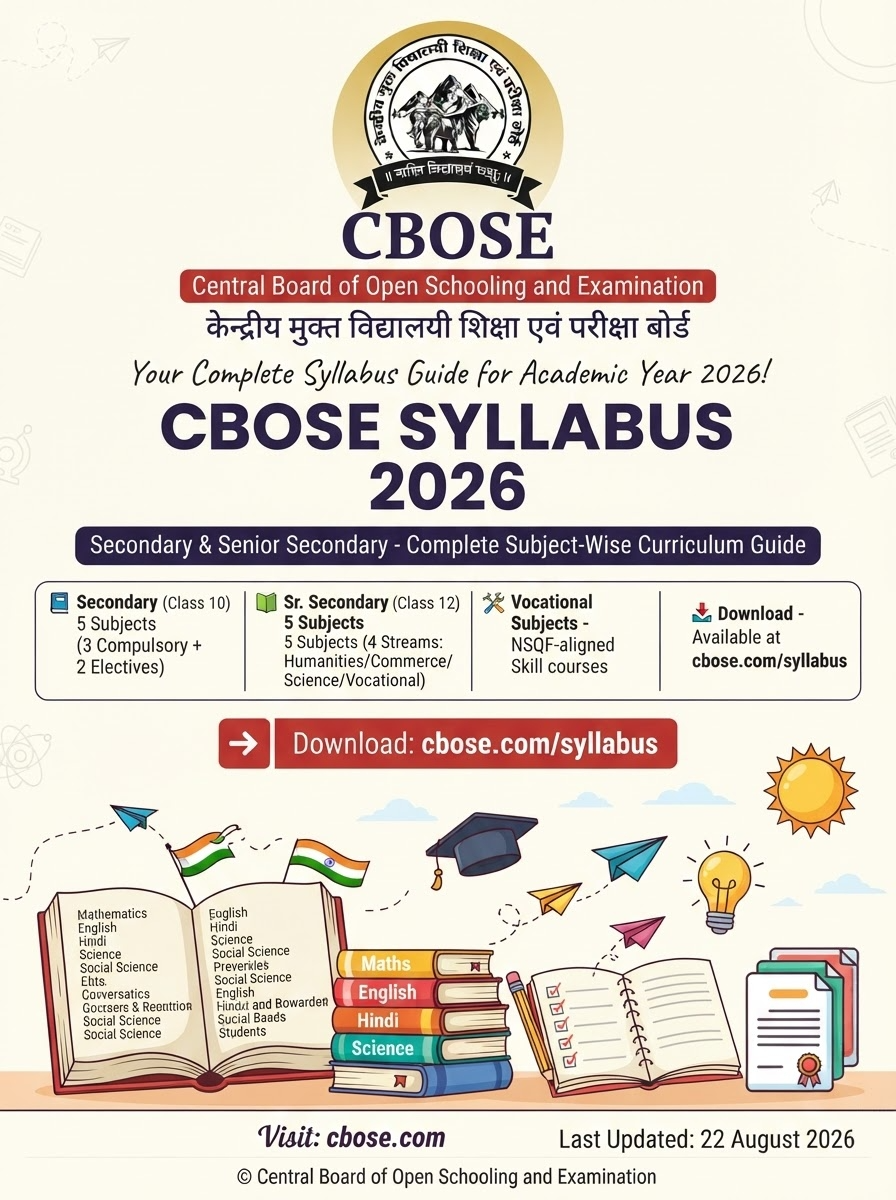
>> The CBOSE syllabus covers Class 10 (5 compulsory + optional) and Class 12 (5 subjects, stream-wise).
>> Each subject carries a marks split: theory (70-80) + practical / project / TMA (20-30).
>> The question paper is split into MCQ + Very Short + Short + Long sections; choice is provided inside Long.
>> The syllabus booklet is downloadable from cbose.com as a PDF, and is also accessible from inside the dashboard at cbose.com/student/login.php.
>> Read the syllabus FIRST - before any textbook. It defines what is examinable and how much each chapter carries.