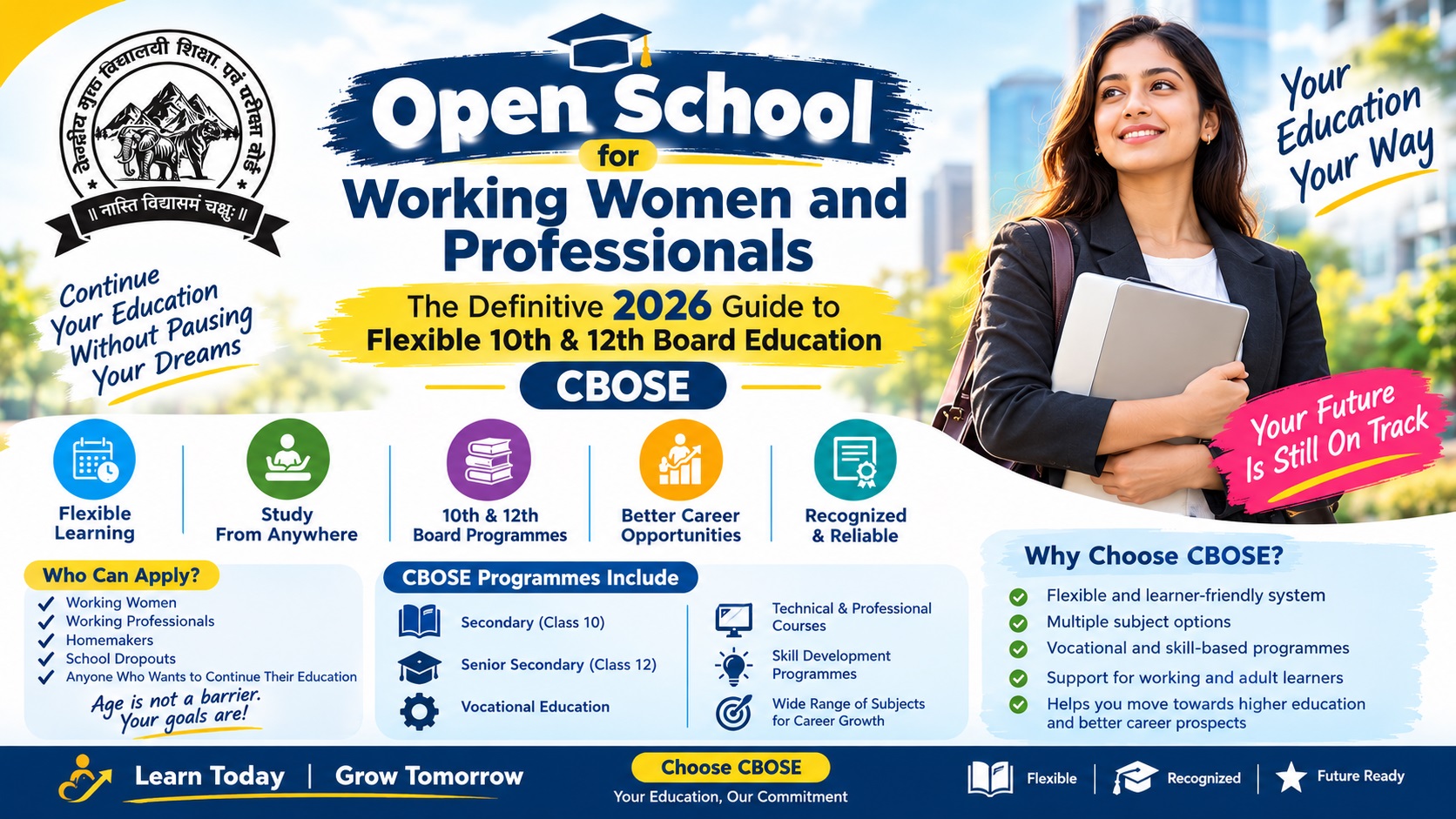
Welcome To Central Board of Open Schooling and Examination
CBOSE in News

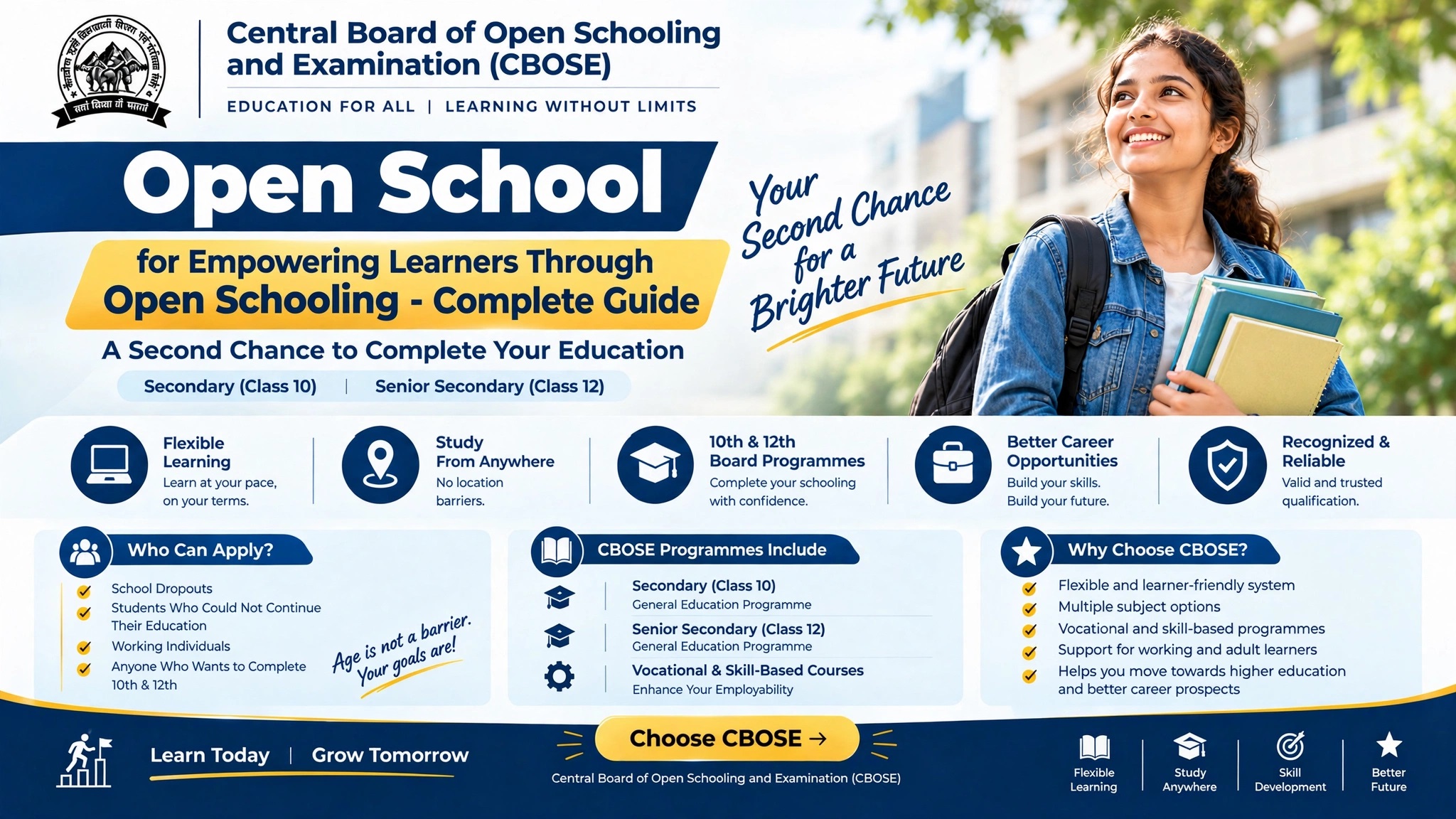
CBOSE: Empowering Learners Through Open Schooling – The Complete Guide
Learn all about the Central Board of Open Schooling and Examination (CBOSE). Explore admission, flexible 10th & 12th curriculum, recognition, and exam system.
In the rapidly transforming landscape of modern education, conventional classroom environments often fall short of serving the diverse needs of non-traditional learners. Whether facing financial hardships, geographical boundaries, job commitments, competitive exam preparation, or personal responsibilities, millions of learners require an academic path that blends rigorous standards with flexible learning. Open schooling bridges this gap effectively.
The Central Board of Open Schooling and Examination (CBOSE) plays a pivotal role in this educational democratization. By breaking geographical and socio-economic barriers, CBOSE delivers accessible secondary (Class 10th) and senior secondary (Class 12th) education to students across the nation. This comprehensive guide details everything about CBOSE—from foundational structure and admission procedures to recognition and exam preparation strategies.
The Central Board of Open Schooling and Examination (CBOSE) was conceptualized to provide customized, learner-centric education under the Open and Distance Learning (ODL) framework. Its primary objective is universalization of school education by facilitating flexible study schedules for all age groups.
Core Objectives of CBOSE:
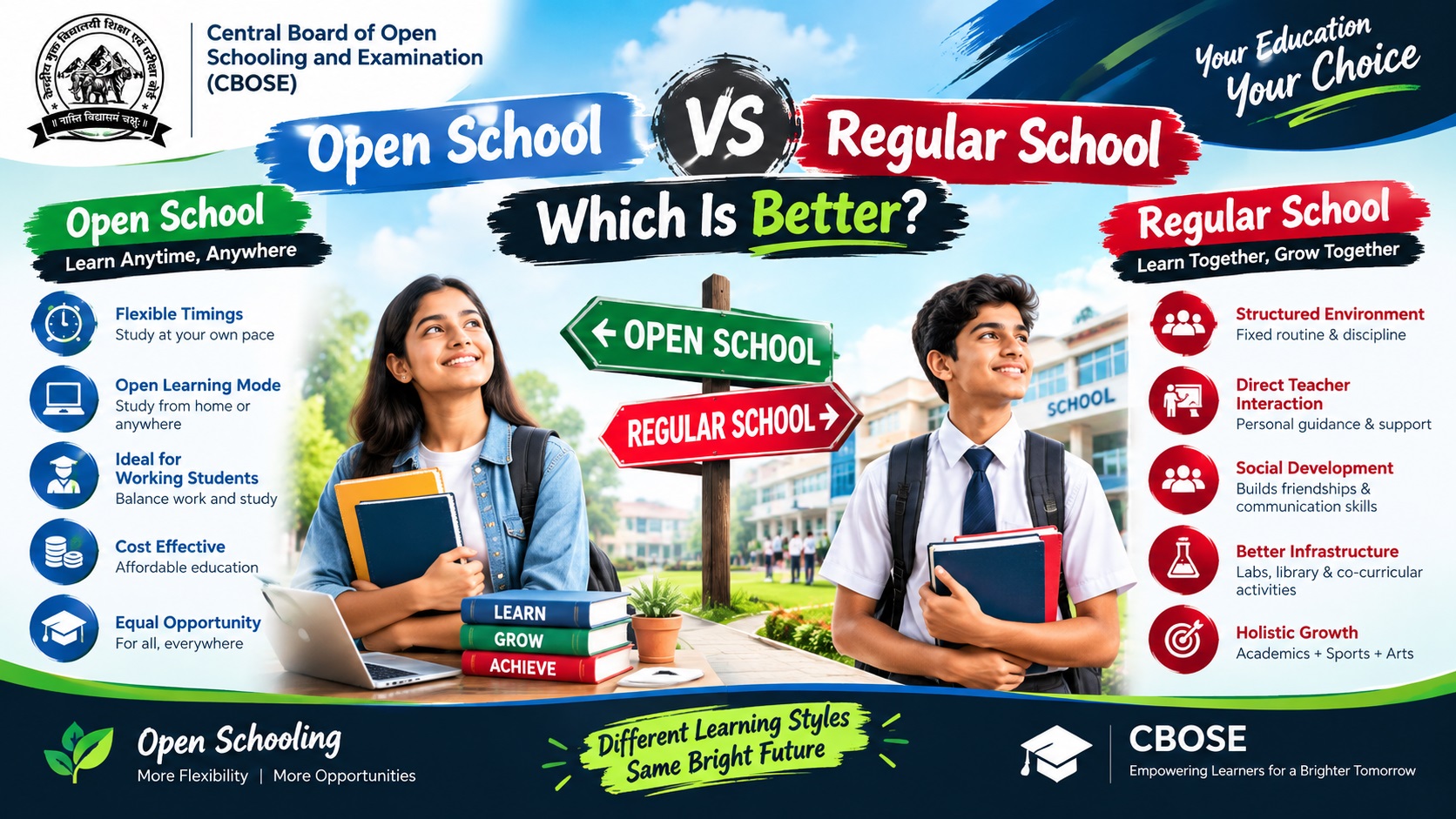
To understand why an increasing number of students opt for the Central Board of Open Schooling and Examination (CBOSE), consider the comparison below:
|
Key Feature |
Conventional Formal Boards |
CBOSE (Open Schooling) |
|
Attendance Requirement |
Mandatory daily attendance (75%+) |
Zero mandatory daily attendance; study at your own pace |
|
Subject Combination |
Rigid streams (Science, Commerce, Arts) |
Flexible interdisciplinary subject selection |
|
Examination Flexibility |
Fixed annual examination dates |
Biannual exams with up to 9 attempts across 5 years |
|
Credit Transfer (TOC) |
Limited or unavailable across boards |
Transfer of Credit (TOC) for up to 2 subjects from recognized boards |
|
Affordability |
High institutional fees & overheads |
Affordable and subsidized fee structures |
|
Competitive Exam Sync |
Heavy school schedules conflict with coaching |
Full autonomy for NEET, JEE, CUET, NDA, & CA preparation |
The Central Board of Open Schooling and Examination (CBOSE) offers recognized certification programs at both Secondary and Senior Secondary levels:
Designed to build foundational academic competency and qualify students for higher secondary education:
Designed for specialized streams leading to university degree programs, vocational diplomas, or professional exams:
Admission to the Central Board of Open Schooling and Examination (CBOSE) is simple, transparent, and learner-friendly. Candidates can apply through accredited study centers or official web portals:
Step 1: Check Eligibility & Age Criteria
Verify that minimum age conditions (14+ for 10th, 10th passed for 12th) are met with supporting age proof.
Step 2: Choose Study Centre / Accredited Institution
Select your nearest designated CBOSE study centre for physical document verification, PCP classes, and study material collection.
Step 3: Online Registration & Form Submission
Complete the application form with personal details, educational history, subject preferences, and chosen medium of instruction (Hindi / English).
Step 4: Upload Mandatory Documentation
Provide Aadhaar card, recent photographs, date of birth certificate, previous academic mark sheets (for 12th admission or TOC claims), and category certificates if applicable.
Step 5: Fee Payment & Enrollment Acknowledgment
Pay the prescribed registration and exam fees via online payment gateway or authorized bank challan. Retain the enrollment receipt for tracking.
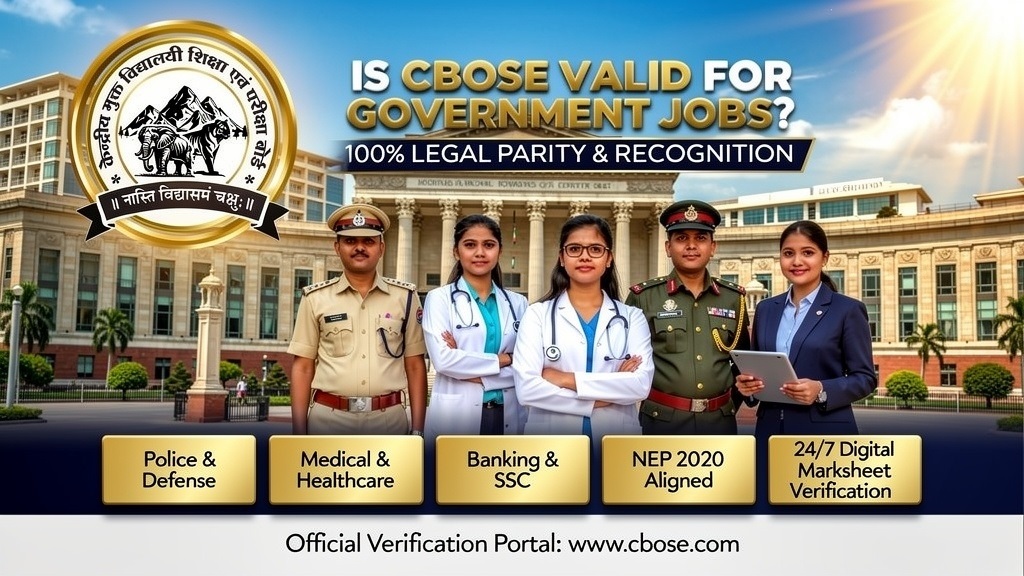
A frequent query among parents and learners is: 'Is the Central Board of Open Schooling and Examination (CBOSE) certificate valid for government jobs and higher studies?'
CBOSE certifications are recognized for legitimate academic progression and competitive opportunities across various domains:
CBOSE implements a supportive, low-stress examination model designed to foster genuine understanding rather than rote memorization:
|
Evaluation Component |
Structure & Weightage |
Student Benefit |
|
Biannual Examinations |
Conducted twice yearly (Block 1 & Block 2 cycles) |
Eliminates the fear of losing an entire academic year if a session is missed. |
|
Tutor Marked Assignments (TMA) |
Continuous internal assessments submitted at study centres (~20% weightage) |
Boosts aggregate percentage and encourages regular syllabus review. |
|
Practical Examinations |
Conducted for Science, Computer Science, and vocational subjects |
Provides essential laboratory and practical domain experience. |
|
9 Exam Chances (5 Years) |
5-year enrollment validity with up to 9 consecutive exam attempts |
Students can clear 1–2 subjects at a time at their own pace. |
|
Transfer of Credit (TOC) |
Transfer passing marks for up to two subjects from other recognized boards |
Prevents re-appearing in subjects already cleared in prior boards. |
Follow these proven preparation strategies to secure top marks in CBOSE examinations:
1. Thoroughly Study Official Self-Learning Material (SLM): CBOSE textbooks are curated specifically for distance education with in-text questions and self-check summaries.
2. Submit Quality Tutor Marked Assignments (TMAs): Timely submission of well-researched assignments significantly elevates your overall score.
3. Solve Past Years' Question Papers: Understand chapter-wise mark distribution, frequently asked concepts, and question framing formats.
4. Attend Personal Contact Programmes (PCP): Benefit from weekend counseling and doubt-clearing sessions organized at accredited study centres.
5. Maintain a Daily Self-Study Routine: Dedicate 3–4 uninterrupted hours daily to stay consistent and cover the entire syllabus systematically
Q1: What is the full form of CBOSE?
CBOSE stands for Central Board of Open Schooling and Examination.
Q2: Is a CBOSE certificate valid for government jobs in India?
Yes. CBOSE certificates from recognized open boards are valid for both Central and State Government employment, including UPSC, SSC, Railways, Defense, and State Services.
Q3: Can CBOSE 12th pass students appear for NEET and JEE Main?
Yes. Candidates completing Senior Secondary from recognized Open School boards with requisite subjects (Physics, Chemistry, Biology/Mathematics) are eligible for NEET-UG and JEE Main under current national guidelines.
Q4: What is the enrollment validity period in CBOSE?
Registration in CBOSE remains valid for 5 years, giving students up to 9 consecutive examination chances to pass all subjects.
Q5: How does Transfer of Credit (TOC) work in CBOSE?
Under the TOC facility, candidates who previously appeared in another recognized board (like CBSE, CISCE, or State Boards) and passed in 1 or 2 subjects can transfer those marks directly to CBOSE, appearing only for the remaining subjects.