Welcome To Central Board of Open Schooling and Examination
CBOSE in News

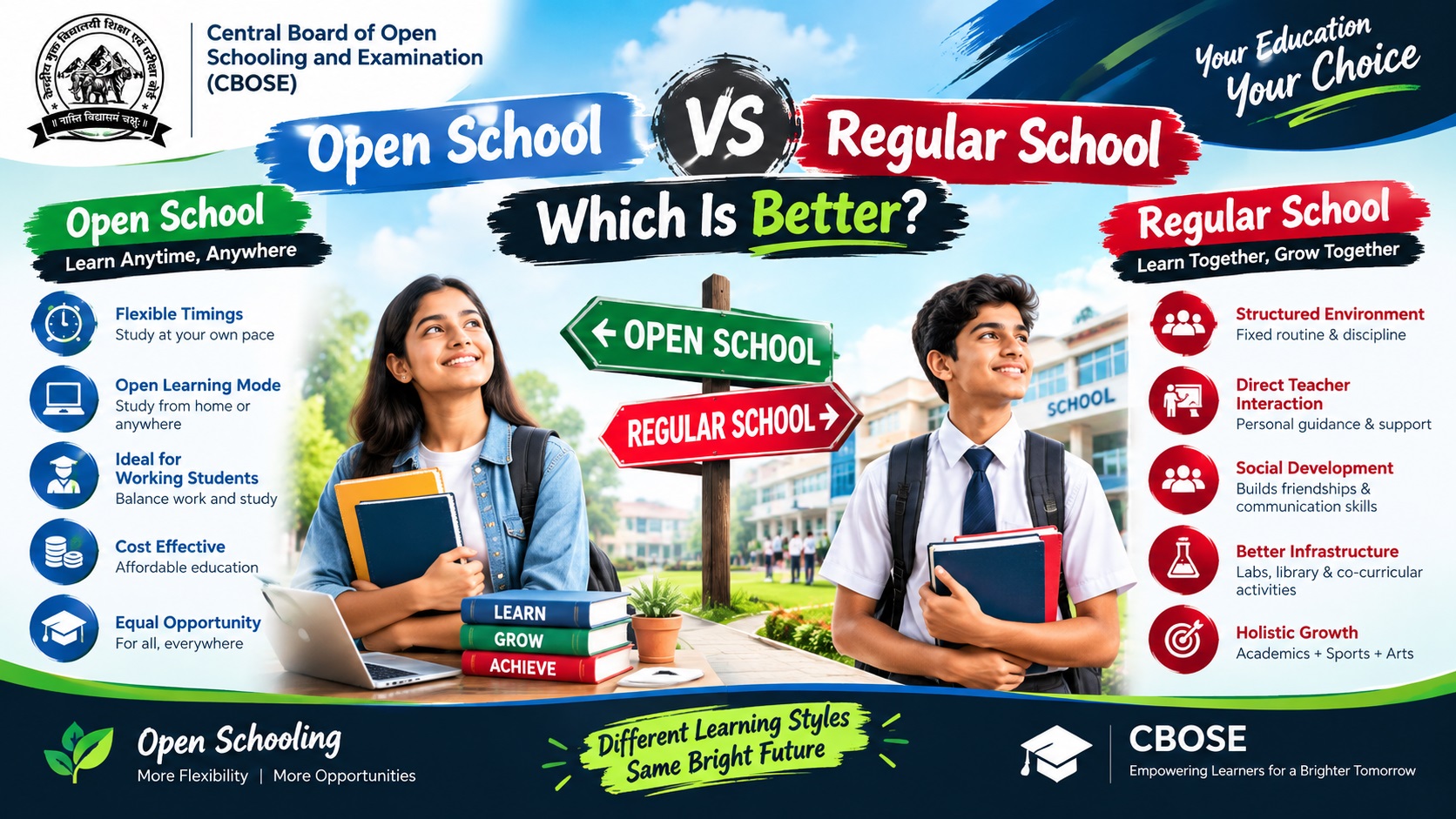
Open School vs Regular School: Which Is Better?
Open School vs Regular School: Which Is Better? | CBOSE — Compare Open Schooling and Regular Schooling to understand their key differences, benefits, flexibility, eligibility, learning options, and examination patterns. Discover how CBOSE Open School can support students seeking flexible and accessible education.
The traditional perception of school education in India has always centered on regular schooling—waking up early, wearing a uniform, attending 6 to 8 hours of daily classroom lectures, participating in morning assemblies, and strictly adhering to minimum 75% mandatory attendance. However, over the past decade, the educational paradigm has undergone a dramatic transformation.
With the surge in high-stakes competitive examinations (JEE Main & Advanced, NEET-UG, CLAT, CUET, NDA), the rise of adolescent sports prodigies and artists, and the demand for flexible schedules, Open Schooling has emerged as a mainstream, highly viable alternative rather than just a safety net for dropouts.
Regular schooling is a formal, classroom-based educational model where students are physically present at an affiliated institution 5 to 6 days a week. It follows a fixed academic calendar, mandatory timetable, structured teacher-student interactions, continuous assessments, laboratory practicals, sports periods, and co-curricular events.
Open schooling (also known as Open and Distance Learning - ODL at school level) is a flexible education delivery model where physical daily attendance is not mandatory. Students receive self-instructional study materials, have access to Personal Contact Programmes (PCP), and can appear for exams at their own pace within an extended timeframe (up to 5 years with 9 exam attempts in NIOS).
To help students and parents evaluate both models objectively, here is a granular comparison across 10 critical academic and lifestyle parameters:
|
Feature / Parameter |
Regular School (CBSE / ICSE / State) |
Open School (NIOS / CBOSE / State Open) |
|
Daily Attendance Requirement |
Mandatory (Strict 75% attendance rule required to appear in board exams) |
Zero mandatory daily attendance (Optional weekend PCP classes) |
|
Learning Flexibility |
Rigid daily timetable (8:00 AM - 2:30 PM) |
100% self-paced; study anytime, anywhere |
|
Subject Combination Freedom |
Strict stream bundles (Science: PCM/PCB; Commerce; Arts) |
Total freedom: Cross-stream combos (e.g., Physics + Accounts + Painting) |
|
Time for Competitive Coaching |
Limited (School 6-7 hrs + Coaching 4-5 hrs = High burnout risk) |
Maximum (Full day available for self-study and coaching classes) |
|
Social & Soft Skills Development |
High (Peer bonding, stage exposure, group projects, sports) |
Independent (Requires external sports/social avenues) |
|
Examination Structure |
Annual/Term-wise single sitting examinations |
Flexible: On-Demand Examination (ODE) + Public Exams twice a year |
|
Fee Structure & Cost |
Moderate to Very High (INR 30,000 - 2,50,000+ per year) |
Extremely Affordable (INR 2,000 - 5,000 total registration fee) |
|
Credit Transfer Facility |
Generally restricted/cumbersome transfer policies |
Transfer of Credit (TOC) allows up to 2 passed subjects from other boards |
|
Validity & Legal Recognition |
100% recognized across India & globally |
100% equivalent & recognized by MHRD, AIU, UPSC, NTA, NEET, JEE |
|
Practical Science Labs |
Hands-on daily/weekly structured lab sessions |
Conducted during mandatory PCP practical sessions at study centers |
Understanding the institutional credibility, curriculum depth, and governance of each major board is essential for long-term academic planning.
|
Board Name |
Authority & Governance |
Target Student Demographic |
Exam Cycle & Flexibility |
|
CBSE (Central Board of Secondary Education) |
Central Govt (Ministry of Education) |
Regular students seeking structured national schooling |
Annual Board exams (Feb-April), strict syllabus schedule |
|
CBOSE (Central Board of Open Schooling and Examination) |
Open Schooling Examination Board |
Distance learners, flexible pace aspirants, private candidates |
Bi-annual / flexible exam sessions |
|
NIOS (National Institute of Open Schooling) |
Autonomous Body under Ministry of Education, GoI |
JEE/NEET aspirants, working youth, sports prodigies, private candidates |
Twice a year (April-May & Oct-Nov) + On-Demand Exam (ODE) |
|
ICSE / ISC (CISCE) |
Private National Regular Board |
Students focusing on deep literature, language proficiency & STEM |
Rigorous comprehensive annual examination pattern |
Advantages / Key Strengths:
Disadvantages / Limitations:
Advantages / Key Strengths:
Disadvantages / Limitations:
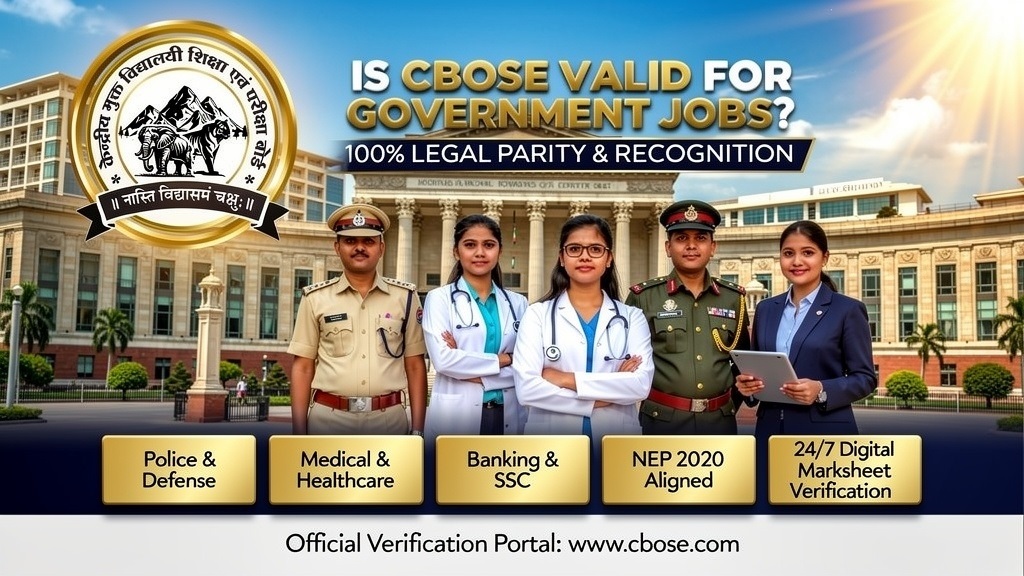
The biggest question asked by parents and students is: 'Will an Open School certificate be valid for College Admissions, Medical/Engineering Entrance, and Government Jobs?'
The unequivocal answer is YES. Here is the verified legal framework:
There is no one-size-fits-all answer. The choice between Open Schooling and Regular Schooling depends entirely on your career goals, personal discipline, and learning style.
|
Student Profile / Situation |
Recommended Board Model |
Core Strategic Rationale |
|
Intense JEE / NEET / CA Aspirant |
Open School (NIOS) |
Eliminates 75% attendance burden; saves 7+ hours daily for high-intensity coaching & self-study. |
|
Overall Personality & Social Growth Focused |
Regular School (CBSE/ICSE) |
Maximizes peer bonding, extracurricular participation, sports, and structured routine. |
|
Athletes, Artists & Performing Prodigies |
Open School (NIOS/CBOSE) |
Provides complete timetable flexibility for national/international training, tours, and competitions. |
|
Struggling with Conventional Pace / Saved Year |
Open School (TOC System) |
Allows self-paced exam scheduling, subject credit transfer, and stress-free graduation. |
|
Traditional College Path (General Arts/Commerce) |
Regular School (CBSE/State) |
Fosters networking, consistent school records, and conventional university transition. |
|
Working Professionals / Upskilling Youth |
Open School (NIOS/State Open) |
Permits parallel job continuation while upgrading basic educational qualifications. |
To maximize the benefits of Open Schooling and avoid its pitfalls, adopt these proven strategies:
Q1: Is Open School (NIOS/CBOSE) certificate valid for Government Jobs in India?
Yes. Certificates issued by NIOS or state open boards established by statutory acts are 100% valid and legally recognized for all Central and State Government examinations, including UPSC, SSC, Railways, Banking, Police, and Defence forces.
Q2: Can an NIOS / Open School student crack NEET and become a Doctor?
Absolutely. The National Medical Commission (NMC) allows NIOS students who have completed 10+2 with Physics, Chemistry, Biology/Biotechnology, and English to appear for NEET-UG. Many NIOS students successfully secure admissions in top government medical colleges (AIIMS, JIPMER, state GMCs) every year.
Q3: Does Regular School have an advantage in Foreign University admissions?
Top foreign universities assess applications holistically (grades, SOP, letters of recommendation, extracurricular leadership, and SAT/ACT/IELTS scores). While Regular School makes it easier to obtain teacher recommendation letters and school profile documentation, NIOS students with strong portfolios and standardized test scores are equally accepted.
Q4: Can I shift from Regular CBSE School to NIOS in Class 11 or 12?
Yes. Students can easily transition from CBSE/ICSE to NIOS for Senior Secondary (Class 11/12). Furthermore, if a student has already passed certain subjects in Class 10/12 from CBSE, they can utilize the Transfer of Credit (TOC) scheme to carry forward marks.
Q5: Which is harder: CBSE or NIOS exam?
The syllabus depth for Science and Commerce in NIOS is equivalent to CBSE (both follow NCERT guidelines). However, NIOS offers greater examination flexibility (TMA weightage, On-Demand exams, and choice of subjects), making the overall passing experience less stressful.