Welcome To Central Board of Open Schooling and Examination
CBOSE in News

CBOSE | And the Future of Open Schooling in India
A Comprehensive Strategic Analysis on NEP 2020 Reforms, Digital Accreditation, and the Modern Paradigm of Flexible Secondary Education
India's secondary and higher secondary education landscape is experiencing an unprecedented structural transformation. Driven by the visionary goals of the National Education Policy (NEP 2020), the traditional model of schooling—characterized by rigid attendance, fixed examination calendars, and compartmentalized academic streams—is rapidly making way for flexible, inclusive, and learner-centric frameworks. Central to this mission is the national goal of achieving a 100% Gross Enrolment Ratio (GER) in preschool to secondary education by 2030 through Open and Distance Learning (ODL).
At the vanguard of this modern wave stands the Central Board of Open Schooling and Examination (CBOSE). Bridging the historic divide between non-formal distance education and standard collegiate entrance requirements, CBOSE has institutionalized a high-rigor, stream-aligned Class 10 and 12 pedagogical model. By seamlessly integrating Science (PCM/PCB), Commerce, and Humanities with 24x7 digital verification dashboards and On-Demand Examinations, CBOSE represents the definitive benchmark for the future of open schooling in India.
Modern open schooling has outgrown the perception of being merely a 'second-chance fallback' for dropouts. Today, it operates as a sophisticated, preference-first alternative tailored to athletes, competitive exam aspirants (JEE/NEET), working professionals, and neurodiverse learners. CBOSE anchors this transformation across five strategic pillars:
To understand how CBOSE is spearheading next-generation distance learning, the matrix below details key structural comparisons against traditional open boards:
|
Key Evaluation Metric |
CBOSE (2026 Modern Benchmark) |
Traditional Central Model (NIOS) |
State Open Schools (RSOS/MPSOS) |
|---|---|---|---|
|
Pedagogical Orientation |
Stream-aligned Class 10/12 for university degree & competitive exam parity |
Broad non-formal and vocational education basket |
Regional vernacular welfare and state drop-out reduction |
|
Senior Secondary (Class 12) Structure |
Standard 3-Stream grid (Science, Commerce, Arts) matching college cutoffs |
Flexible subject basket without mandatory faculty segregation |
State-prescribed curriculum, often lacking nationwide stream uniformity |
|
Examination Flexibility |
On-demand supplementary cycles & rapid re-entry sessions |
Twice-yearly public examinations plus On-Demand exams |
Fixed annual or bi-annual state board schedule |
|
Digital Verification Speed |
Instant real-time portal authentication (cbose.com/student/login.php) |
Online SDMIS verification system (nios.ac.in) |
Manual physical verification or state departmental portals |
|
NEET / JEE / CUET Eligibility |
100% Eligible with core science/math subject combinations |
100% Eligible as per NTA guidelines |
Eligible, often subject to state domicile certificates |
|
Credit Banking / NCrF Alignment |
Active adoption of NEP 2020 National Credit Framework |
Pioneered credit transfer system (TOC) |
Gradual phased transition under state educational policies |
NEP 2020 explicitly highlights Open and Distance Learning (ODL) as an essential vehicle for democratization of schooling. With secondary school GER hovering around 79% in 2021-22, achieving 100% GER by 2030 requires absorbing over 10 million out-of-school and non-traditional students into formal secondary pathways. The chart and data below highlight the projected enrolment expansion in Indian open schooling through 2030.
| 2020 | 2022 | 2024 | 2026 (Est.) | 2028 (Proj.) | 2030 (Target) | |
|---|---|---|---|---|---|---|
| Total Open Schooling Enrolment (Lakhs) | 28.5 | 33 | 39.5 | 47 | 56.5 | 68 |
One of the most frequently asked questions on Google regarding open schooling is:
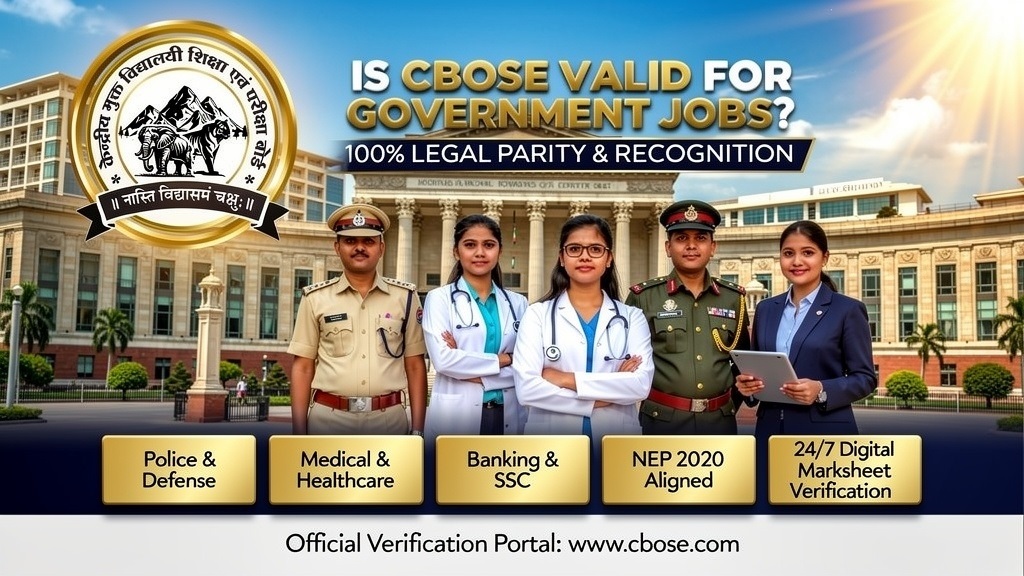
'Is CBOSE valid for government jobs and college admissions?'
The answer is an unequivocal YES. Under established constitutional and administrative jurisprudence, secondary and higher secondary certificates issued by recognized open boards hold complete parity with traditional state and central boards:
As India moves towards Viksit Bharat 2047, the convergence of artificial intelligence, blockchain, and micro-credentialing is reshaping flexible education:
1. AI-Driven Personalized Mentorship & Dynamic Remediation
Future open schooling platforms are deploying generative AI study companions that adapt instructional complexity to individual student paces, offering real-time multilingual doubt clearance in 22 regional Indian languages.
2. Blockchain-Based Tamper-Proof Digital Credentialing
Integration with DigiLocker and sovereign blockchain ledgers ensures that certificates and academic transcripts are globally verifiable in under 3 seconds, eliminating fraudulent credentials.
3. Hybrid Study Centers & Mobile Science Labs
To deliver rigorous practical training for Science stream candidates (PCM/PCB), modern open boards are partnering with local degree colleges and ITIs, providing weekend hands-on laboratory experiences.
4. Lifelong Learning & Modular Certification
Learners can take individual modular subjects over extended intervals, accumulating stackable credits under the Academic Bank of Credits (ABC) to earn their diploma without burnout.
The following high-intent questions address the primary search queries submitted by students, parents, and recruiters across Google:
Q1: What is CBOSE and how does it fit into India's open schooling ecosystem?
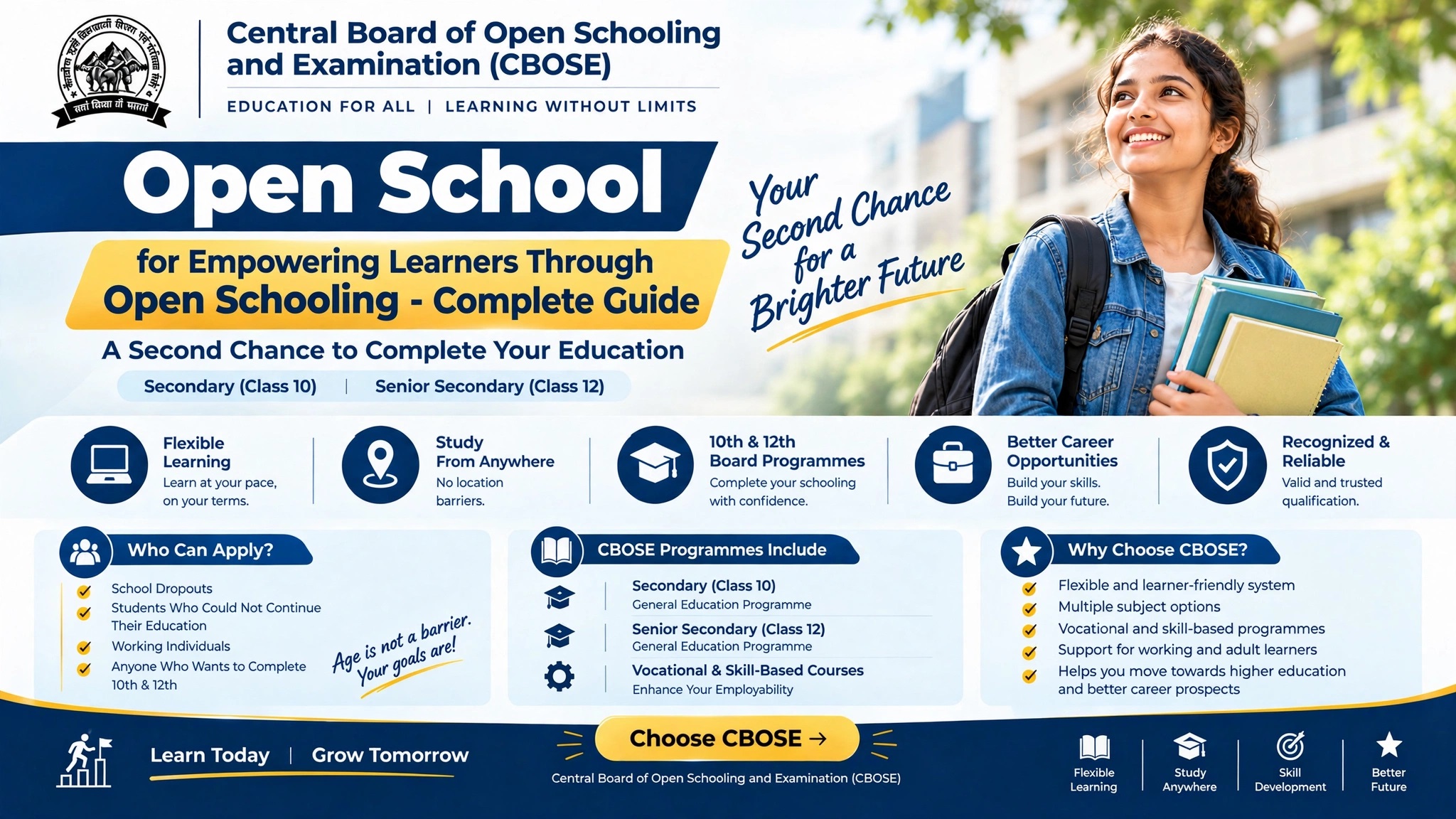
The Central Board of Open Schooling and Examination (CBOSE) is a national-level open schooling organization established under the Societies Registration Act, 1860 and recognized through official Gazette notifications. It offers flexible, stream-aligned Class 10 (Secondary) and Class 12 (Senior Secondary) education.
Q2: Is a Class 12 certificate from CBOSE eligible for NEET and JEE Main?
Yes. Candidates passing Class 12 from CBOSE with required core subjects (Physics, Chemistry, and Biology/Mathematics) fulfill the eligibility norms specified by the National Testing Agency (NTA) for both NEET-UG and JEE Main examinations.
Q3: Can students from CBOSE apply for Central and State Government Jobs?
Yes. CBOSE certificates are valid for government employment including SSC (MTS, GD, CHSL), India Post (GDS), Indian Railways (RRB), State Police Services, and Defence recruitment drives, subject to meeting standard post-specific requirements.
Q4: How does CBOSE differ from traditional open boards like NIOS?
While both offer flexible open education, CBOSE emphasizes standard collegiate stream alignment (Science, Commerce, Arts) to prevent university admission hurdles, rapid On-Demand examination cycles, and an instant 24x7 online marksheet verification dashboard at cbose.com.
Q5: How can recruiters or universities verify CBOSE marksheets online?
Employers, verification agencies, and universities can authenticate student credentials in real-time by visiting the official student portal at cbose.com/student/login.php and entering the student's Roll Number and Enrollment ID.
Q6: Who benefits most from enrolling in CBOSE open schooling?
CBOSE is ideal for: (1) Students preparing full-time for competitive examinations like NEET/JEE/CA-Foundation; (2) Working professionals seeking promotion through secondary education; (3) Dropouts looking to complete high school without losing years; and (4) Sportsspersons and performing artists requiring flexible schedules.