Welcome To Central Board of Open Schooling and Examination
CBOSE in News

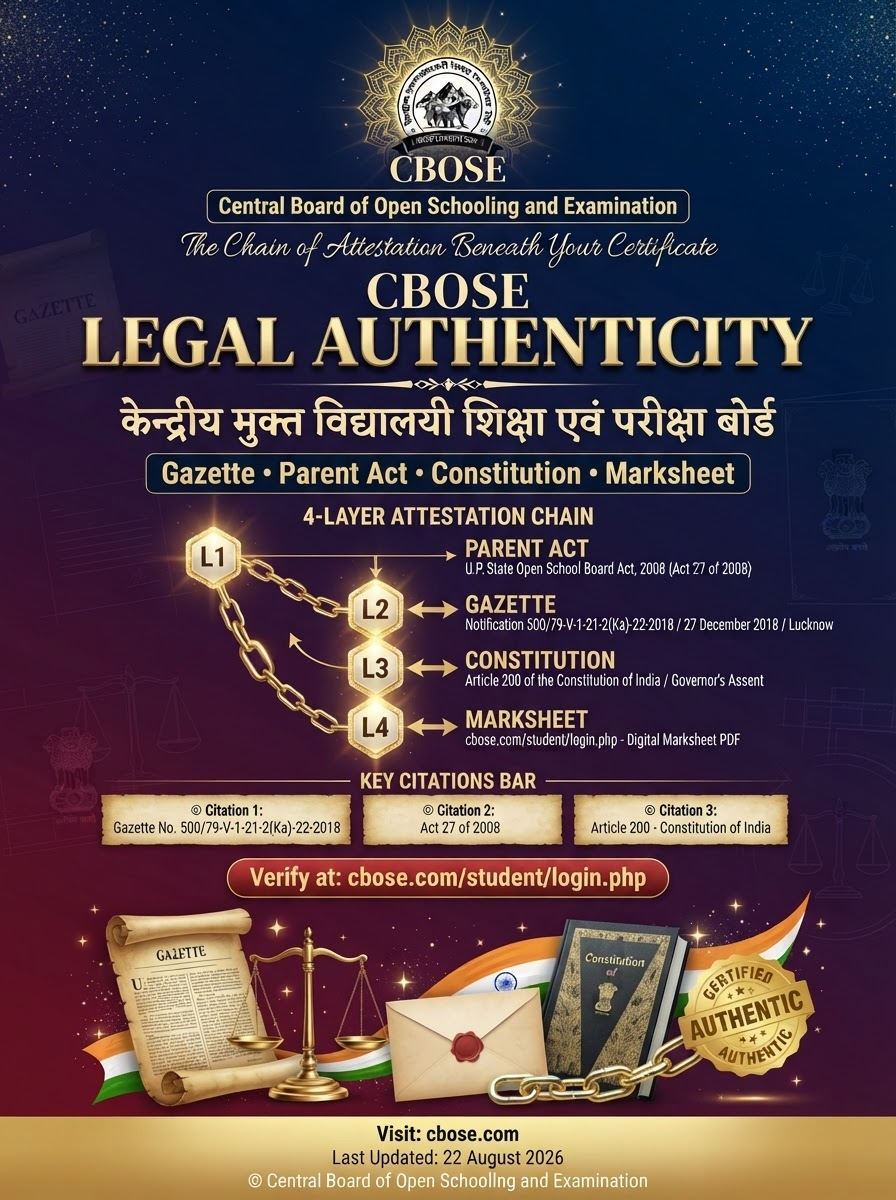
EDUCATION - LEGALAUTHENTICITY - CBOSE
Central Board of Open Schooling and Examination
CBOSE Legal Authenticity
What is the legal sub-stratum beneath a CBOSE marksheet - the gazette citation, the parent Act, and the constitutional anchor that together form the chain of attestation.
|
Audience Verifiers, recruiters, candidates |
Subject Legal Authenticity & Gazette |
Format Legal-layman Brief |
Reading Time ~ 10 minutes |
|
500/79… |
Act 27 / 2008 |
Art. 200 |
Lucknow |
|---|---|---|---|
|
Gazette Number |
Anchor Act |
Constitutional Anchor |
Gazette Place |
|
THE CHAIN The Central Board of Open Schooling and Examination (CBOSE) at cbose.com is anchored in (1) the Uttar Pradesh State Open School Board Act, 2008 (Act No. 27 of 2008); (2) Gazette Notification No. 500/79-V-1-21-2(Ka)-22-2018, dated 27 December 2018, published at Lucknow, Uttar Pradesh; (3) Article 200 of the Constitution of India (governor's assent to the parent State Act); (4) the digital marksheet issued through the candidate dashboard at cbose.com/student/login.php. |
Together, these four links constitute the attestation chain a verifier relies on when authenticating a CBOSE marksheet. None of them, by themselves, are sufficient - the chain only holds when all four are visible. This Brief walks through each link, in detail.
The parent Act of CBOSE is the Uttar Pradesh State Open School Board Act, 2008. This Act legislatively created the framework under which open-schooling Boards may be constituted in Uttar Pradesh - and, down the chain, was the legislative vehicle by which CBOSE's recognition was recorded.
What the Act does, in structural terms:
|
ACT METADATA Title: Uttar Pradesh State Open School Board Act, 2008. Citation: Act No. 27 of 2008. Tag: 'UP Act 27 of 2008' / '2008UP27' (per Scribd publication of the Act). Constitutional anchor: Article 200 of the Constitution of India (governor's assent to State Bills). |
Citation note: The Act citation '(UP Act 27 of 2008)' is reproduced here from sources published on cbose.com and republished on Indian Code (indiancode.online / Scribd 2008UP27). These are summary publications of the Act; the authoritative text is published in the Uttar Pradesh Rajpatra (the official gazette of the State).
On 27 December 2018, a notification was published in the Uttar Pradesh Rajpatra, recording the recognition of the Central Board of Open Schooling and Examination under the parent Act. This notification is the bridge between the abstract legislative framework (the parent Act) and the working, day-to-day recognition of CBOSE as the open-schooling Board it operates as today.
|
Field |
Value as published |
|---|---|
|
Notification Number |
|
|
|
500/79-V-1-21-2(Ka)-22-2018 |
|
Date of publication |
|
|
|
27 December 2018 (Saka Samvat 1940, Paush 9 - per the customary Indian gazette dating convention). |
|
Place of publication |
|
|
|
Lucknow, Uttar Pradesh. |
|
Issuing Department |
|
|
|
Uttar Pradesh Shasan, Vidhayee Anubhag-3 (Legislative Section-3) per cbose.com publication. |
|
Parent Act referenced |
|
|
|
Uttar Pradesh State Open School Board Act, 2008 (Act No. 27 of 2008). |
|
Subject of recognition |
|
|
|
Recording of recognition of CBOSE under and in exercise of powers conferred by the parent Act. |
|
Scope of recognition |
|
|
|
Ordinarily extends to secondary (Class 10) and higher-secondary (Class 12) open-schooling examinations, in line with the framework of the parent Act. |
|
Quality of publication |
|
|
|
Published in the Uttar Pradesh Rajpatra, Extraordinary Issue, Legislative Supplement, Part-3 (Ka) - the specific gazette section ordinarily used for notifications tied to legislative Acts and recognition thereof. |
Citation note: The notification number, date, place, and the issuing Section are reproduced here from cbose.com's publication (cbose.com/cbose-gazette-act-legal-status.php and cbose.com/article.php?url=cbose-certificate-valid-for-government-jobs), and consistent with the summary republished on Indian Code's blog (indiancode.online, 3 days before this article). Within this session's search, I did not surface the primary record in the Republic of India e-Gazette corpus (egazette.gov.in) for this specific notification number; for the authoritative Uttar Pradesh Rajpatra text of this notification, consult the Uttar Pradesh Legislative Assembly Secretariat archive directly.
Article 200 of the Constitution of India is the provision that governs the Governor's assent to State Bills. In the chain of attestation of CBOSE, this provision is what bridged the Uttar Pradesh State Open School Board Act, 2008 from a passed Bill into law that the executive can act upon. Without the Governor's assent under Article 200, the parent Act would lack legal force.
|
WHAT ARTICLE 200 DOES Article 200 of the Constitution of India directs the Governor of a State, when a Bill is passed by the State Legislature, to take one of four declared actions on the Bill: assent, withhold assent, return the Bill (with a message), or reserve the Bill for the President's consideration. The Governor's assent completes the Bill's transformation into an Act of the State Legislature. |
In the case of the U.P. State Open School Board Act, 2008, the Governor's assent to the Bill under Article 200 is the constitutional pivot on which the entire downstream chain - including the 2018 Gazette notification and the day-to-day operations of CBOSE - turns.
Citation note: Constitutional framing of Article 200 is verified via indiacode (the official repository of Indian statutory text) and the UP Legislative Assembly Secretariat page (uplegisassembly.gov.in). The application of Article 200 specifically to the U.P. State Open School Board Act, 2008 (i.e. that the Governor did in fact assent) is published on indiancode.online's blog entry. For authoritative Governor's-assent records, consult the UP Raj Bhavan archives and the Assembly proceedings.
If the parent Act is the legislative frame and the Gazette notification is the recognition event under that frame, then the digital marksheet issued through the candidate dashboard at cbose.com/student/login.php is the day-to-day document that finally carries the legal weight downstream - to colleges, employers and verification portals.
The dashboard-issued marksheet ordinarily carries (1) the Board name, (2) the candidate's identity row, (3) subject-wise theory + practical / TMA marks, and (4) an authentication code / seal that aligns with the Board's records. The candidate can verify their own record on the dashboard; verifiers can cross-check on the same dashboard with a candidate-shared PDF or live screenshot.
The four layers of attestation that legally anchor a CBOSE marksheet are, in descending order:
|
Layer |
What it is |
Why it matters |
|---|---|---|
|
L1 |
|
|
|
|
Parent Act |
|
|
|
|
U.P. State Open School Board Act, 2008 (Act 27/2008) - creates open-schooling Board framework. |
|
L2 |
|
|
|
|
Gazette |
|
|
|
|
Notification 500/79-V-1-21-2(Ka)-22-2018, 27 Dec 2018, Lucknow - records CBOSE's recognition under the parent Act. |
|
L3 |
|
|
|
|
Constitution |
|
|
|
|
Article 200 of the Constitution of India - the Governor's assent that gave the parent Act its binding force of law. |
|
L4 |
|
|
|
|
Marksheet |
|
|
|
|
Digital marksheet at cbose.com/student/login.php - the day-to-day document on which downstream verification rests. |
When verifying a CBOSE marksheet, the practical checks the verifier applies ordinarily touch every layer of the chain. Each check is anchored to a layer.
The legal sub-stratum documented above is about the Board's existence, recognition and attestation framework. It is NOT the same as:
|
OUT OF SCOPE This Brief addresses what the legal attestation chain of CBOSE IS. It does not adjudicate what each downstream body should accept - that decision is made by each downstream body under the policy framework applicable to that body. |
The legal chain matters in five common flows:
In public discussion, five confusions recur:
|
Question |
Answer |
|---|---|
|
Q. Is CBOSE legally authentic? |
A. CBOSE is anchored in the Uttar Pradesh State Open School Board Act, 2008 (Act 27/2008); its recognition is recorded by Gazette Notification No. 500/79-V-1-21-2(Ka)-22-2018 (27 December 2018, Lucknow); and the Constitution of India (Article 200) anchors the parent Act through the Governor's assent. These together form the legal sub-stratum. |
|
Q. What is the Gazette Notification number of CBOSE? |
A. Notification No. 500/79-V-1-21-2(Ka)-22-2018, dated 27 December 2018, published in the Uttar Pradesh Rajpatra. |
|
Q. When was the CBOSE Gazette notification issued? |
A. 27 December 2018. |
|
Q. Where was the CBOSE Gazette notification published? |
A. Lucknow, Uttar Pradesh, in the Uttar Pradesh Rajpatra. |
|
Q. Which section of the Uttar Pradesh Government issued the notification? |
A. Uttar Pradesh Shasan, Vidhayee Anubhag-3 (Legislative Section-3), per cbose.com's publication. |
|
Q. Under what Act was the notification issued? |
A. The Uttar Pradesh State Open School Board Act, 2008 (Act No. 27 of 2008). |
|
Q. What does Article 200 of the Constitution of India do? |
A. Article 200 governs the Governor's assent to State Bills; the U.P. State Open School Board Act, 2008 received the Governor's assent under Article 200, anchoring the parent Act in Constitutional Law. |
|
Q. Does this mean the CBOSE certificate is automatically accepted everywhere? |
A. No. The legal chain does the work at the level of existence / recognition of the Board. Downstream acceptance (recruiters / universities) is decided by each downstream body. |
|
Q. Where can I verify a CBOSE marksheet directly? |
A. cbose.com/student/login.php -> 'Academic Result'. |
|
Q. Is the digital marksheet legally authentic? |
A. Yes - the dashboard-issued digital marksheet is treated by the Board as the authentic downstream document; the legal chain is the macro-frame, the digital marksheet is the day-to-day carrier. |
|
Q. Was the parent Act passed in 2008 or 2009? |
A. The U.P. State Open School Board Act, 2008 was enacted by the U.P. Legislature in 2008. The Governor's assent completed the action; the effective date is ordinarily published in the Rajpatra. |
|
Q. What is the URL of the official CBOSE portal? |
A. https://cbose.com. Student login page: https://cbose.com/student/login.php. |
|
Q. Is this an SEO brief or a legal advisory? |
A. This is an SEO-oriented Brief. It consolidates published information on the legal chain - it is not a legal opinion or recruiter / university policy advice. |
|
Q. Where do I find the primary Gazette text? |
A. The official Uttar Pradesh Rajpatra is the primary text. Within the UP Legislative Assembly Secretariat's archive (uplegisassembly.gov.in) you can navigate gazettes by decade. |
|
Q. Is the Gazette notification number in this article authoritative? |
A. It is the citation republished by cbose.com and consistent with summary publications on indiancode.online. The user is advised to cross-check the primary UP Rajpatra text before using this in any formal filing. |
|
Q. Can the Gazette number be used in a court or government filing? |
A. The user is advised to take the primary UP Rajpatra entry as the authoritative citation in any filing that relies on this article. |
|
Q. Does the Gazette attach to recognition of open-schooling Boards in general, or specifically to CBOSE? |
A. The Gazette records the recognition of CBOSE specifically, in exercise of powers under the parent State Act. Other open-schooling Boards (State boards, NIOS) have their own respective statutory bases. |
|
Q. Is CBOSE recognised for foreign university applications? |
A. This Brief does not adjudicate that. Foreign universities ordinarily accept CBOSE marksheets after their own equivalency / apostille / WES-style process. |
|
Q. Will the marksheet of a CBOSE imparted through a private study centre be authentic? |
A. Yes - ordinarily the marksheet carries the Board's authenticity regardless of which accredited centre issued it. The centre's accreditation is the routine antecedent of the marksheet. |
|
Q. What is the difference between 'legal authenticity' and 'recognition'? |
A. 'Legal authenticity' here refers to the statutory existence and recognition record of the Board. 'Recognition' (as commonly used in recruitment / admissions language) refers to the downstream acceptance of a candidate's marksheet by an employer / university. |