Welcome To Central Board of Open Schooling and Examination
CBOSE in News

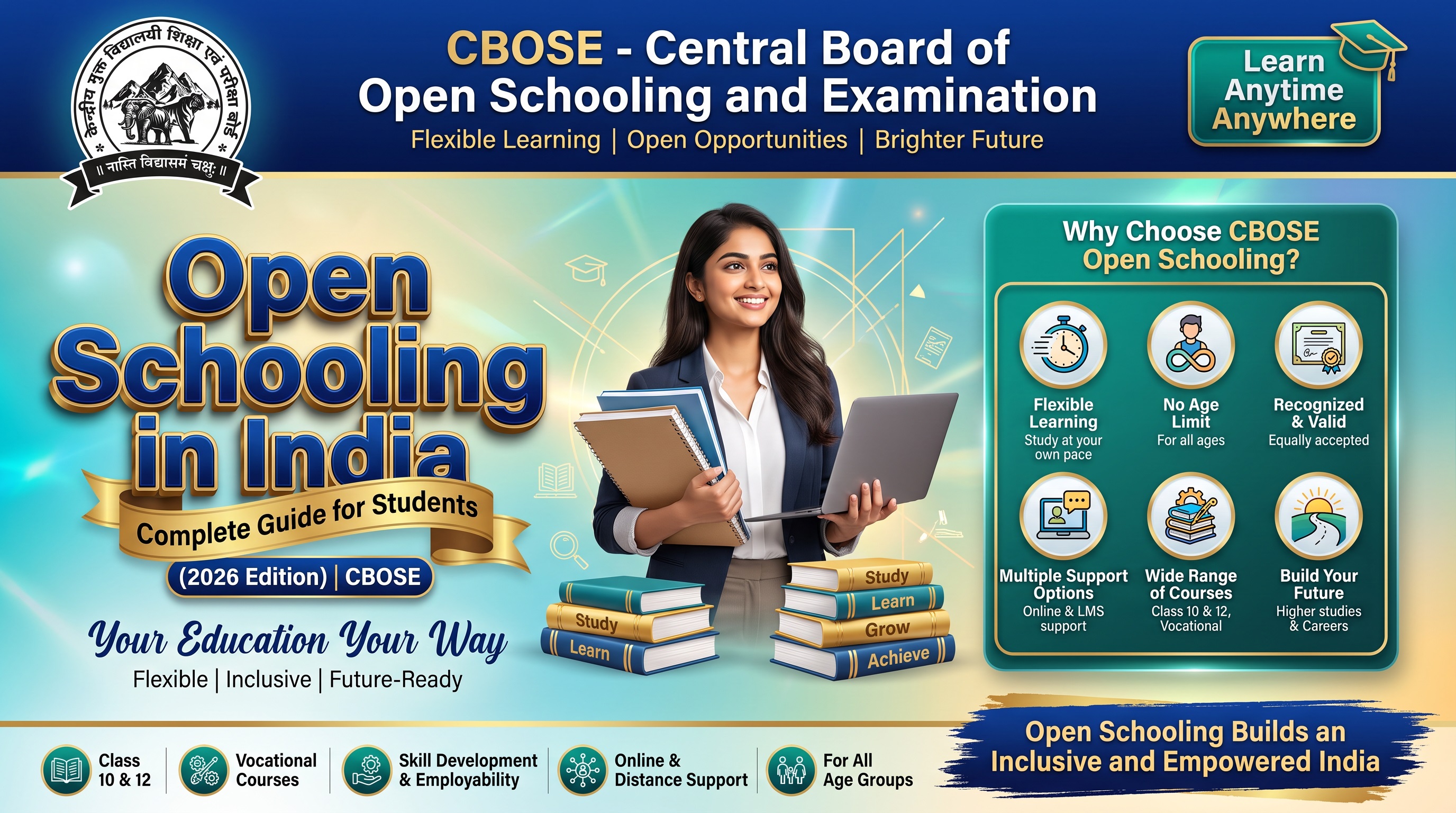
Open Schooling in India: Complete Guide for Students (2026 Edition)
Explore this complete guide to open schooling in India, including eligibility, admission process, subjects, examinations, benefits, recognized open boards, flexibility, and career opportunities. Learn how open schooling can help students continue their education with flexible study options in 2026.
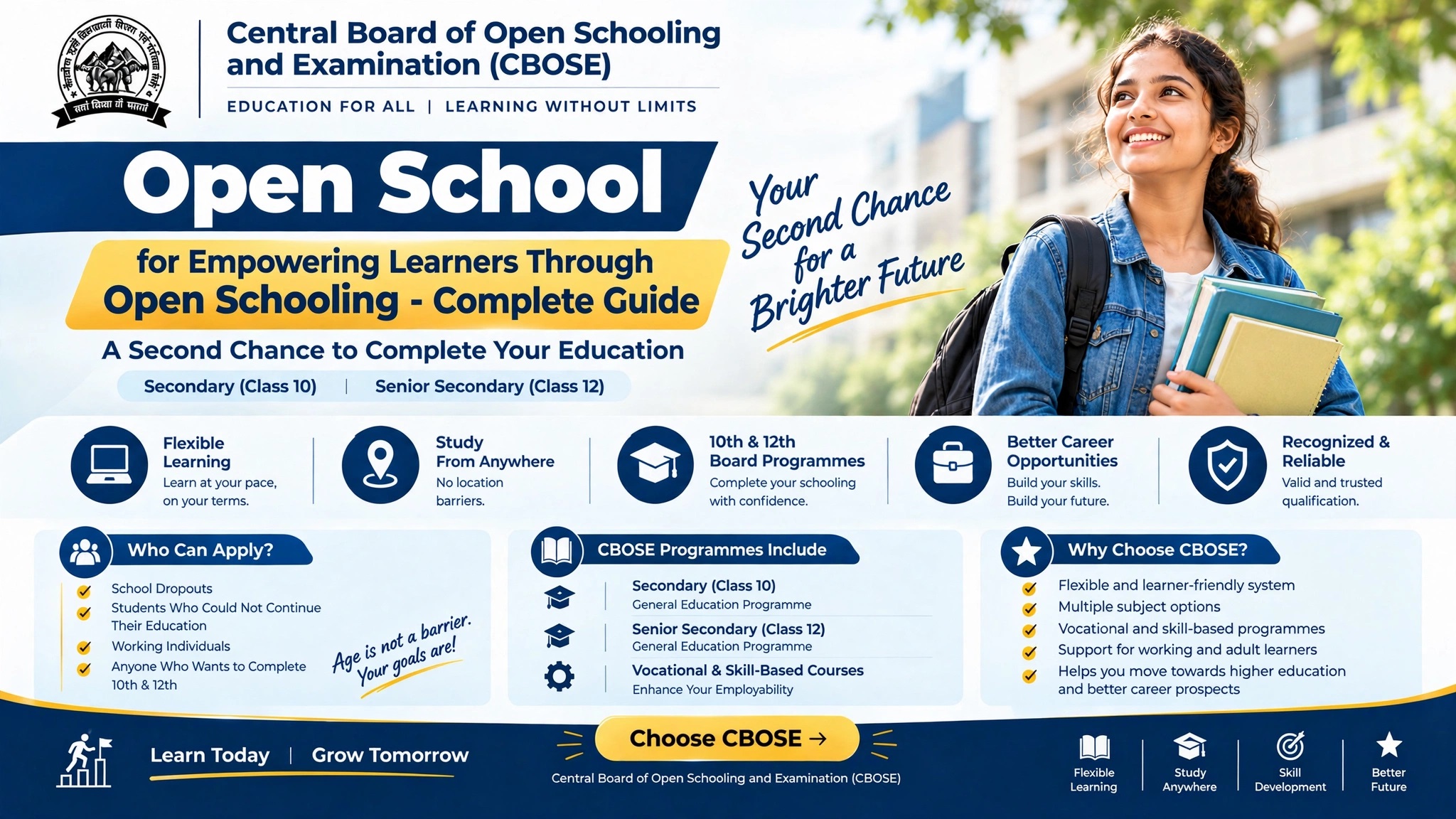
In India, Open Schooling is an accredited non-formal education system designed to offer flexible, high-quality, and accessible secondary (10th) and senior secondary (12th) education to anyone who cannot attend traditional regular schools. Whether due to financial constraints, early employment, sports/arts commitments, medical reasons, or the desire to focus exclusively on competitive entrance exams (like NEET, JEE, CUET, CA Foundation), open schooling removes the barrier of mandatory daily physical attendance.
Under the visionary framework of modern distance education, boards like the Council of Basic and Open Schooling Education are revolutionizing the Indian education system in 2026. CBOSE leverages 100% digital admissions, comprehensive e-learning portals, self-paced modules, and on-demand examinations to make quality education accessible to every corner of India. This comprehensive guide covers everything you need to know about embarking on your open schooling journey in 2026.
Open schooling caters to diverse groups of ambitious learners across India:
• Competitive Exam Aspirants: Medical (NEET) and Engineering (JEE) students who need 10–12 hours of self-study and coaching every day.
• Working Professionals & Job Holders: Individuals working full-time or part-time who need 10th or 12th certificates for job promotions and career growth.
• School Dropouts & Fail Students: Learners who could not clear board exams previously and want to save their academic year through Transfer of Credit (TOC).
• Athletes, Artists & Performers: Young achievers who spend significant time in daily training, tournaments, and rehearsals.
• Differently-Abled & Rural Students: Learners facing geographical barriers, physical mobility constraints, or socio-economic challenges.
CBOSE offers two primary benchmark educational programs:
|
Program Level |
Standard Equivalent |
Entry Eligibility |
Key Focus Areas |
|
Secondary Course |
10th Standard / Matriculation |
Passed 8th/9th or self-declaration (Min Age: 14 Years) |
Languages, Mathematics, Science & Tech, Social Science, Business Studies |
|
Senior Secondary Course |
12th Standard / Intermediate |
Passed 10th from any recognized board (Min Age: 15 Years) |
Science (PCB/PCM), Commerce, Humanities/Arts, Vocational electives |
1. Freedom of Subject Selection: Unlike rigid conventional boards where subjects are strictly locked into Science, Commerce, or Arts streams, CBOSE allows interdisciplinary flexibility. You can choose subjects aligned with your strengths and future aspirations.
2. On-Demand & Multi-Cycle Examinations: Students do not have to wait a full 365 days for one annual exam. CBOSE offers flexible examination sessions and on-demand exams, giving students complete control over their test schedules.
3. Transfer of Credit (TOC) Scheme: If you failed in another recognized board (CBSE, ICSE, or State Boards) but passed in 1 or 2 subjects, CBOSE allows you to transfer those credits directly, so you only appear for the remaining subjects.
4. 100% Digital Admission & Student Dashboard: The entire admission, fee payment, identity verification, hall ticket issuance, and result publication process is online, eliminating the need to stand in physical queues.
5. 24/7 E-Learning & Digital Books: Students receive comprehensive digital study materials, recorded lectures, sample papers, and modular self-assessments accessible on smartphones and laptops.
Getting enrolled in CBOSE is seamless. Follow this simple 5-step roadmap:
1. Step 1: Check Eligibility & Course Requirements — Ensure you meet the minimum age criteria (14 for 10th, 15 for 12th).
2. Step 2: Choose Subject Combinations — Select a minimum of 5 subjects (including at least one language subject) suitable for your career path.
3. Step 3: Online Registration & Form Fill-up — Visit the official CBOSE digital portal and fill in your basic personal and academic details.
4. Step 4: Upload Required Documents — Upload scanned copies of Aadhaar/ID proof, Date of Birth certificate, previous academic marksheets/school leaving certificate, and a passport-size photograph.
5. Step 5: Pay Admission Fee Securely — Complete payment via UPI, Net Banking, or Credit/Debit card to instantly receive your enrollment number and student portal login.
The chart below reflects the exponential growth in students opting for flexible open schooling across India, driven by entrance exam preparation, working youth, and digital accessibility:
One of the most common myths is that Open School certificates are inferior to regular boards. This is completely false. Qualifications obtained through recognized open boards like CBOSE carry full legal equivalence:
• Higher Education: Eligible for admissions into Bachelor's degrees (B.Tech, MBBS, B.Sc, B.Com, BA, BCA, BBA, LLB) in Central, State, Deemed, and Private universities.
• National Entrance Examinations: 100% eligible for NEET-UG, JEE-Main, JEE-Advanced, CUET, NDA, CLAT, and State CETs.
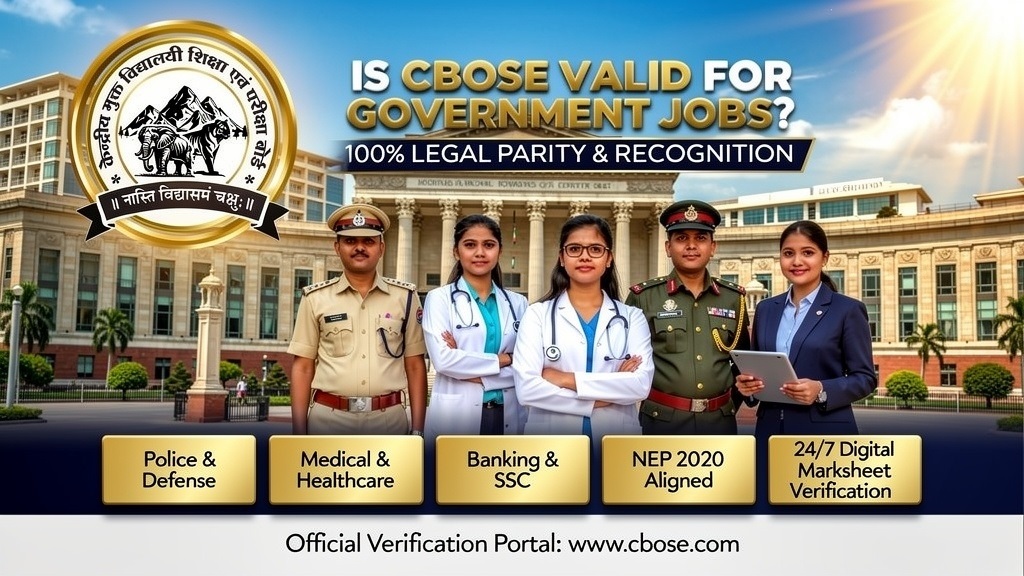
• Government Jobs & Defence: Recognized for UPSC, SSC, Railways, State PSCs, Police, and Armed Forces recruitments.
• Corporate Sector & Promotions: Widely accepted by private sector employers, MNCs, and corporate HRs for career increments.
• Studying Abroad: Recognized for passport verification and international university applications (IELTS/TOEFL).
Q1. What is the full form of CBOSE?
CBOSE stands for Council of Basic and Open Schooling Education.
Q2. Is there any age limit to apply for 10th or 12th in CBOSE?
There is only a minimum age limit (14 years for 10th and 15 years for 12th). There is NO upper age limit, meaning adults and lifelong learners of any age can enroll.
Q3. Are practical exams conducted in open schooling for Science subjects (Physics/Chemistry/Biology)?
Yes. For subjects with practical components (such as Physics, Chemistry, Biology, and Computer Science), designated practical sessions and lab assessments are arranged at authorized study centers.
Q4. Can I change my subjects after taking admission in CBOSE?
Yes. CBOSE provides a student-friendly facility to change or add subjects before the final examination registration through the student dashboard.
Q5. How do I get my final marksheet and passing certificate?
Upon successfully passing all required subjects, CBOSE issues original digital marksheets and migration certificates online, while physical hard copies are dispatched to the student's registered address.