Welcome To Central Board of Open Schooling and Examination
CBOSE in News

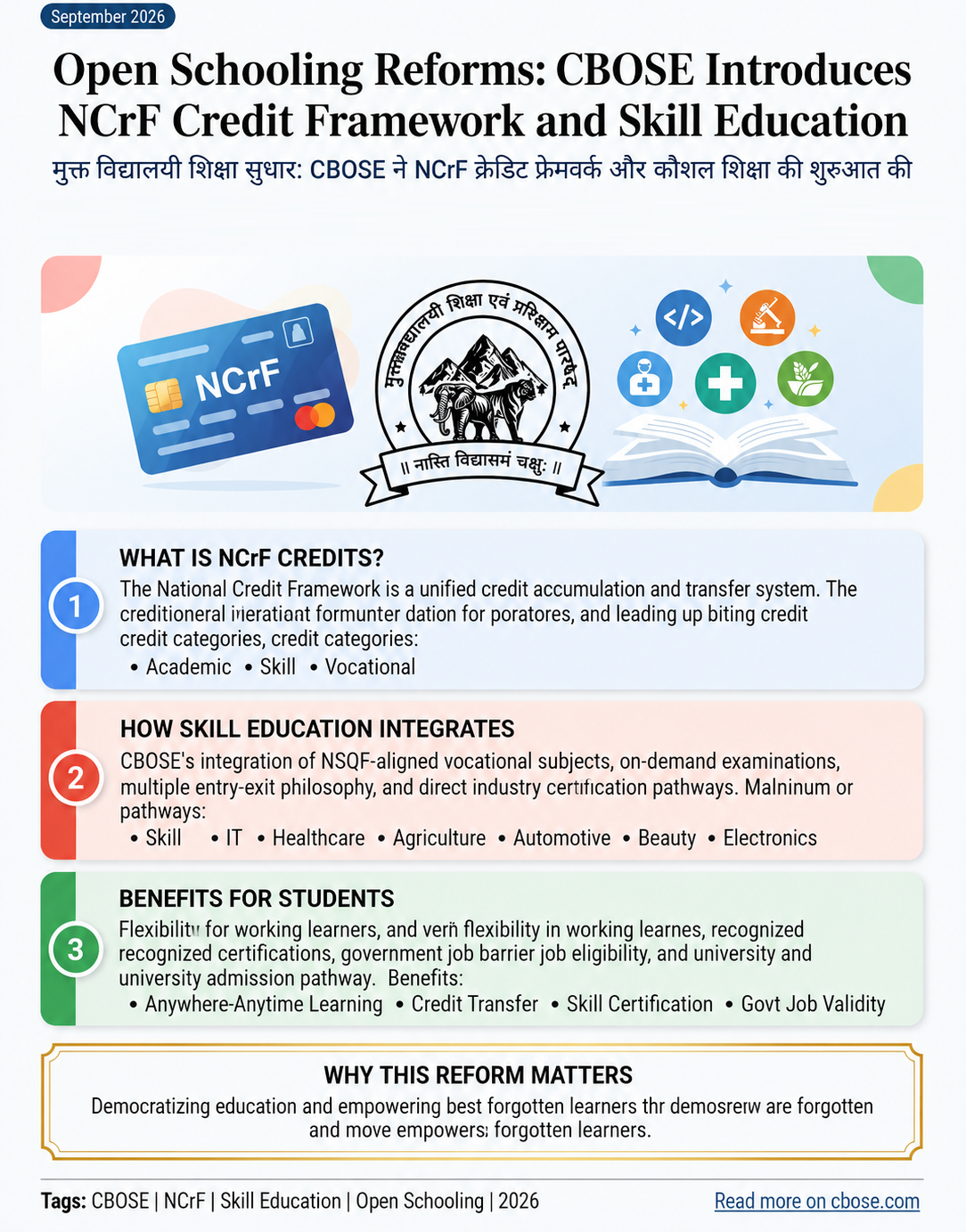
Open Schooling Reforms: CBOSE Introduces NCrF Credit Framework and Skill Education
How the National Credit Framework (NCrF) and NEP 2020-Aligned Vocational Skills are Revolutionizing Flexible Learning at CBOSE
Table of Contents
2. Understanding the National Credit Framework (NCrF) in School Education
2.1 Core Pillars of NCrF Architecture
3. Implementation Matrix: How NCrF Works within CBOSE
4. Transformative Advantages of NCrF for Open Schooling Students
4.1 Elimination of Academic & Vocational Hierarchy
4.2 Multiple Entry and Exit Options (MEES)
4.3 Smooth Credit Mobility with Higher Education Institutions
4.4 Recognition of Prior Learning (RPL)
5. CBOSE Skill Education Ecosystem: Industry-Ready Course Catalog
6. Digital Backbone: APAAR ID and the Academic Bank of Credits (ABC)
7. Impact Analysis: Open Schooling Before vs. After NCrF Reforms
8. How Students Can Enroll in NCrF-Enabled Skill Courses at CBOSE
9. Search Engine Optimization (SEO) Strategy for CBOSE Web Article
10. Frequently Asked Questions (FAQs) for Google Rich Snippets
The landscape of school education in India is undergoing a monumental transformation driven by the National Education Policy (NEP) 2020. To bridge the gap between theoretical academic knowledge and practical vocational competencies, the Council of Basic and Open Schooling Education (CBOSE) has pioneered landmark open schooling reforms by formally integrating the National Credit Framework (NCrF) and an expansive Skill-Based Education ecosystem.
This strategic reform dismantles age-old silos separating mainstream academics from vocational training. Under the NCrF umbrella, open schooling students can now earn, accumulate, and transfer academic credits seamlessly across general education, vocational training, and experiential learning, positioning CBOSE at the forefront of modern, flexible, and employment-oriented education in India.
The National Credit Framework (NCrF) is an overarching unified meta-framework developed jointly by UGC, AICTE, NCVET, NIOS, CBSE, and the Ministry of Education. It establishes a standardized mechanism to quantify learning outcomes into tangible 'Credits' across all stages of education—from foundational school levels to higher education and skilling.
Under CBOSE's reformed curriculum, the academic workload is measured systematically via credit points. A standard academic year equals 40 credits, derived from 1200 notional learning hours (30 notional hours per credit). This allows learners to balance textbooks with hands-on skill workshops without compromising on overall credit requirements.
|
Schooling Level / Grade |
NCrF Credit Level |
Minimum Annual Learning Hours |
Total Credits Earned |
Curriculum Composition |
|---|---|---|---|---|
|
Secondary (Class 10th / 10th Open) |
Level 2.0 to 2.5 |
1,200 Notional Hours |
40 Credits |
60% Core Academics + 40% Vocational / Practical Skills |
|
Sr. Secondary (Class 12th / 12th Open) |
Level 3.0 to 3.5 |
1,200 Notional Hours |
40 Credits |
Flexible ratio: Major academic stream + Applied Skill Modules |
|
Vocational Certificate / Diploma |
NSQF Level 3 & 4 |
600–1,200 Hours |
20–40 Credits |
Industry-led internships, lab work, project assessments |
Table 1: NCrF Credit Level Mapping and Curriculum Distribution at CBOSE.
Historically, vocational education was viewed as a secondary alternative. With NCrF, vocational subjects hold identical credit value to physics, economics, or literature. An A-grade earned in Artificial Intelligence or Digital Media Production contributes equally toward graduation credits.
Students experiencing personal, financial, or geographical constraints no longer lose years of hard work. Credits earned during any term remain safely banked in the student's digital locker, allowing them to pause and resume education at their convenience.
As universities transition to 4-year undergraduate programs under NEP 2020, CBOSE passouts with accumulated NCrF credits can directly transfer into diploma or degree pathways through CUET, ITIs, polytechnics, and skill universities.
For working youth, artisans, and self-taught programmers, CBOSE provides assessment gateways under NCrF to evaluate informal skills and convert real-world experience into official board credits toward 10th or 12th certification.
To ensure every matriculate and intermediate graduate is career-ready, CBOSE has launched futuristic, NSQF-aligned skill modules across high-growth sectors. Students can choose skill electives alongside core academic subjects:
|
Industry Sector |
Offered Skill Modules |
NSQF Level |
Practical Training Focus |
|---|---|---|---|
|
Information Technology & AI |
Python Programming, Web Design, Data Analytics, Cybersecurity Basics |
Level 4 |
Cloud Labs, GitHub Portfolios, Real Projects |
|
Digital Media & Design |
Graphic Design, UI/UX Essentials, Digital Marketing, Animation |
Level 3/4 |
Brand projects, Adobe Suite, Freelance Toolkits |
|
Commerce & Financial Services |
Banking & Tally ERP, Financial Literacy, E-Commerce Operations |
Level 3/4 |
GST filing simulations, spreadsheet modeling |
|
Healthcare & Wellness |
General Duty Assistant, Yoga & Wellness, First Aid Management |
Level 3 |
Clinical workshops & mock hospital simulations |
|
Green Economy & Engineering |
Solar Panel Installation, Electric Vehicle (EV) Basics, IoT Electronics |
Level 4 |
Hardware kits, workshop diagnostics |
Table 2: CBOSE NSQF-Aligned Vocational & Future-Ready Skill Offerings.
To operationalize NCrF seamlessly, CBOSE integrates with the Government of India's APAAR (Automated Permanent Academic Account Registry) ID—popularly known as 'One Nation, One Student ID.' Key digital highlights include:
The impact of introducing NCrF and vocational skilling at CBOSE is summarized in the benchmark comparison below:
|
Evaluation Dimension |
Traditional Open Schooling (Pre-NCrF) |
Reformed CBOSE Open Schooling (Post-NCrF) |
|---|---|---|
|
Learning Measurement |
Marks and percentage only (Rote-heavy) |
Credits based on notional learning hours & competency mastery |
|
Vocational Integration |
Limited, treated as secondary optional subjects |
Fully integrated with equal academic weight and NSQF alignment |
|
Student Mobility |
Rigid; loss of credits upon dropping out |
Seamless credit transfer via APAAR / Academic Bank of Credits |
|
Employability Focus |
Primarily geared towards paper certification |
Hands-on industry projects, certified practical skills, and job readiness |
|
Assessment Method |
One-time terminal paper examinations |
Continuous assessment, Tutor Marked Assignments (TMAs), practical e-portfolios |
Table 3: Comprehensive transformation matrix of CBOSE open schooling.
To rank #1 on Google for keywords surrounding open schooling reforms, NCrF implementation, and skill education, the following on-page SEO parameters must be implemented upon publishing:
|
SEO Element |
Recommended Optimization Data |
|---|---|
|
Primary Target Keyword |
cbose ncrf credit framework, open schooling skill education, cbose reforms 2026 |
|
Secondary / LSI Keywords |
national credit framework open school, apaar id cbose, vocational courses open board 10th 12th, nep 2020 open schooling, academic bank of credits open school |
|
Optimized Meta Title |
Open Schooling Reforms: CBOSE Introduces NCrF Credit Framework & Skill Education |
|
Optimized Meta Description |
Discover how CBOSE is revolutionizing open schooling with the National Credit Framework (NCrF) and NSQF skill courses. Earn credits, learn AI & IT skills, and boost your career. |
|
Target URL Slug |
cbose.ac.in/blog/open-schooling-reforms-ncrf-credit-framework-skill-education |
|
Schema Markup Recommendation |
Article Schema (JSON-LD), FAQPage Schema, CourseList Schema, EducationalOrganization Schema |
|
Internal Linking Architecture |
Link to: CBOSE Admission Portal, Vocational Courses Directory, APAAR Guide, Subject Scheme, Fee Structure |
Table 4: Strategic SEO metadata and keyword optimization blueprint.
Q1: What is the National Credit Framework (NCrF) introduced by CBOSE?
The National Credit Framework (NCrF) is an educational reform under NEP 2020 that assigns credit values to academic subjects, vocational training, and practical learning, allowing students to accumulate and transfer credits seamlessly through the Academic Bank of Credits (ABC).
Q2: How do NCrF credits benefit open schooling students in higher education?
NCrF credits earned in Class 10th and 12th at CBOSE are officially recognized by higher education bodies. These credits allow smooth entry into undergraduate degrees, polytechnics, vocational diplomas, and competitive exams (NEET, JEE, CUET).
Q3: Can a student combine regular academic subjects with vocational skill courses in CBOSE?
Yes. CBOSE offers 100% curriculum flexibility. A student can choose core subjects like Physics and Economics alongside skill-based courses like Artificial Intelligence, Digital Marketing, or Financial Management, with both carrying equal credit weightage.
Q4: What is the role of the APAAR ID in CBOSE Open Schooling?
APAAR ID ('One Nation, One Student ID') serves as the digital identifier where all NCrF credits, certificates, and grades earned at CBOSE are digitally deposited and safely linked with DigiLocker for lifelong accessibility.
Q5: Are CBOSE skill education certificates recognized by employers and universities?
Yes. All skill modules offered by CBOSE are aligned with National Skills Qualifications Framework (NSQF) levels and National Occupational Standards, ensuring high credibility among employers, universities, and government recruitment boards.