Welcome To Central Board of Open Schooling and Examination
CBOSE in News

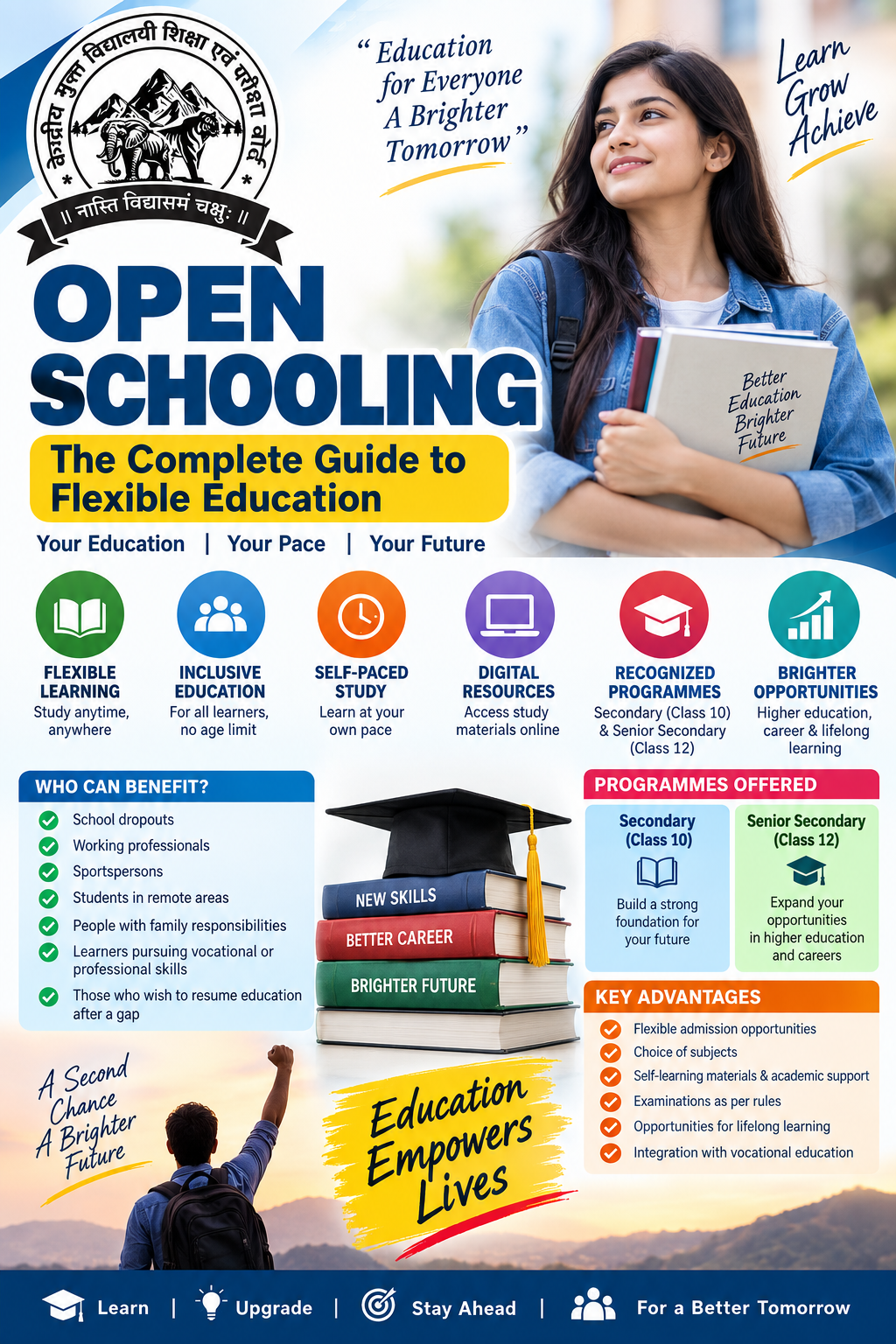
Open Schooling | The Complete Guide to Flexible Education
An In-Depth, SEO-Optimized Resource for Students, Parents, and Educators | CBOSE Knowledge Hub
Table of Contents
1. Introduction: The Evolution of Modern Education
2. What is Open Schooling? Concept & Core Philosophy
3. Comparative Analysis: Open Schooling vs. Conventional Schooling
4. Key Benefits of Open Schooling for Modern Learners
4.1 Ideal for Competitive Exam Aspirants (NEET, JEE, CLAT, CUET)
4.2 Tailored for Athletes, Artists, and Performers
4.3 Second Chance for Dropouts and Working Professionals
4.4 Inclusive Education for Children with Special Needs (CwSN)
5. Recognition & Legal Validity: Higher Education & Competitive Exams
6. How CBOSE (Council of Basic and Open Schooling Education) Supports Learners
7. Step-by-Step Admission Process in Open Schooling
8. On-Page SEO Blueprint: Boosting CBOSE Website Rankings
9. Frequently Asked Questions (FAQs) for High Ranking & Featured Snippets
1. Introduction: The Evolution of Modern Education
In an era defined by digital transformation and personalized learning, traditional rigid classroom models are no longer the only pathway to academic success. Open Schooling has emerged as a revolutionary educational framework designed to deliver flexibility, inclusivity, and high-quality education to diverse learners worldwide. Whether accommodating competitive exam aspirants, professional athletes, working individuals, or students seeking a self-paced learning journey, open schooling dismantles geographical and scheduling barriers.
For institutions like the Council of Basic and Open Schooling Education (CBOSE) and national boards such as NIOS, the mission is crystal clear: democratize quality education and ensure no student is left behind due to socio-economic, physical, or logistical constraints.
2. What is Open Schooling? Concept & Core Philosophy
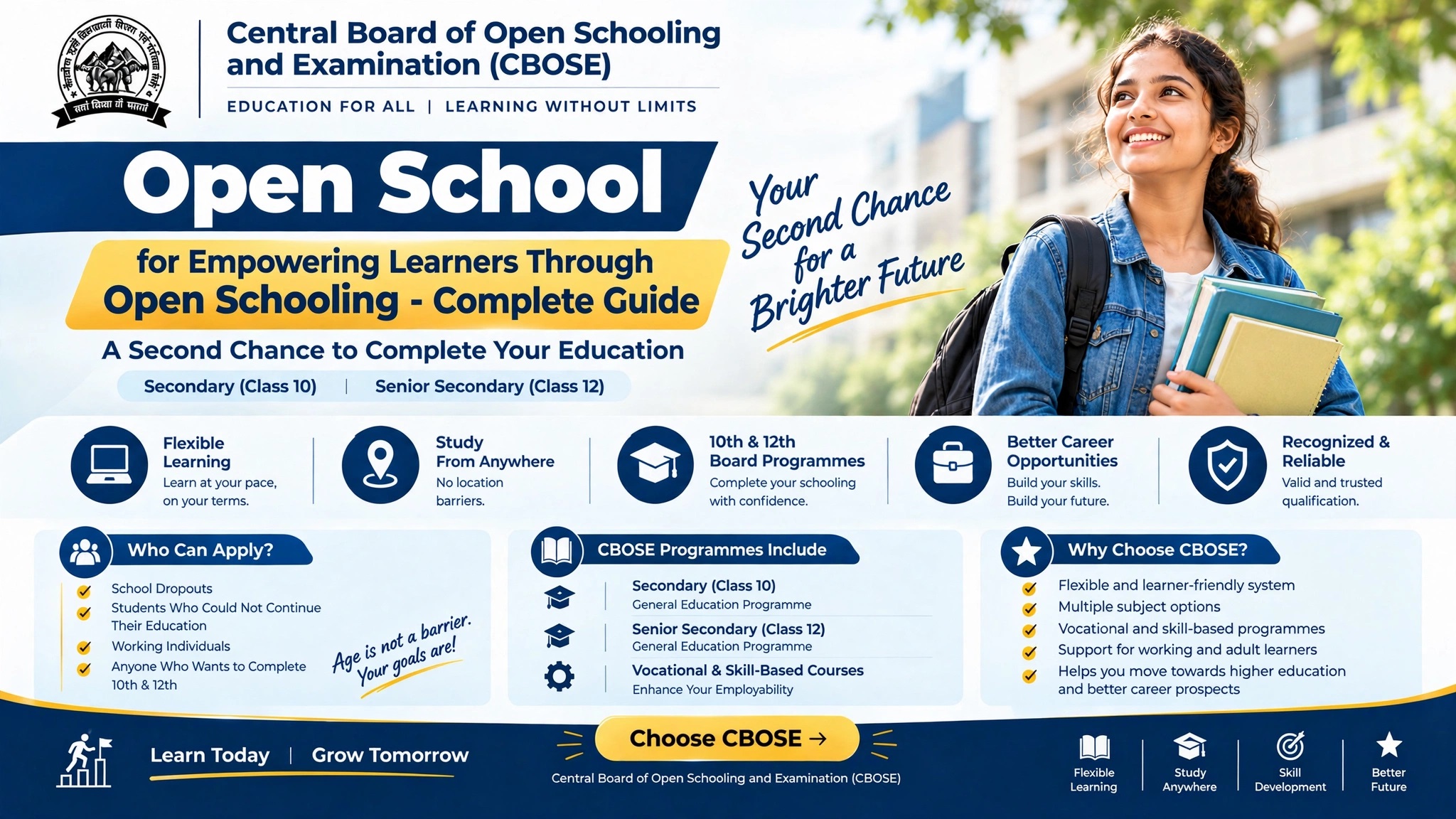
Open Schooling refers to an open and distance learning (ODL) system at the school level (Secondary/10th and Senior Secondary/12th). Unlike conventional formal schooling requiring strict daily attendance and rigid subject packages, open schooling offers:
Self-Paced Learning: Study at your own rhythm without the pressure of rigid timelines.
Flexible Subject Selection: Freedom to combine academic, vocational, and skill-based subjects without stream constraints.
On-Demand & Bi-Annual Examinations: Appear for examinations when you are fully prepared.
Credit Transfer (TOC): Transfer marks/credits from previous recognized boards to complete incomplete qualifications.
Wide Accessibility: High-quality study material, digital e-content, and localized support centers (PCPs).
3. Comparative Analysis: Open Schooling vs. Conventional Schooling
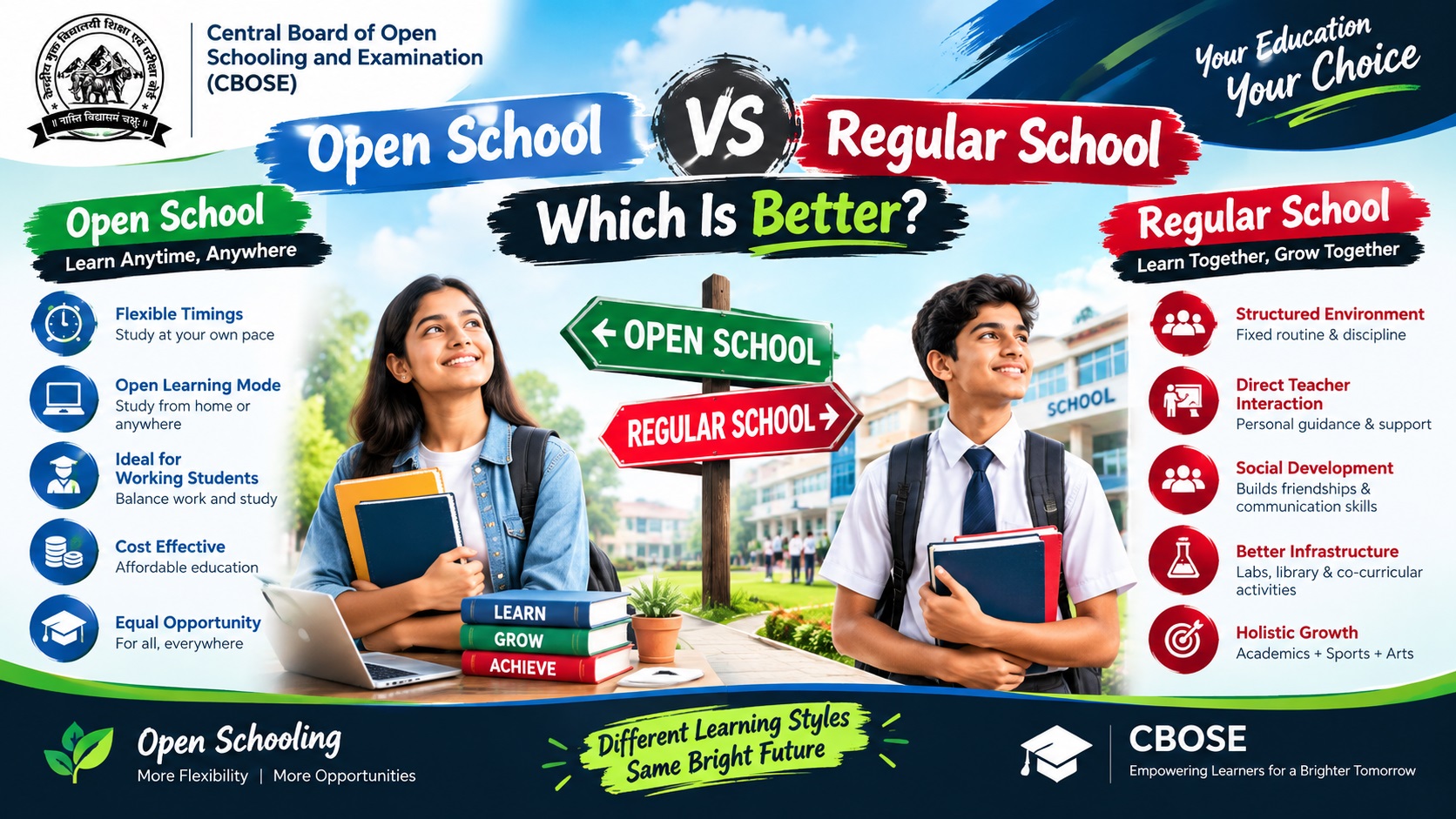
To help students and parents make informed decisions, here is a structured comparison between open schooling and traditional regular schooling systems:
|
Parameter |
Open Schooling (e.g., CBOSE / NIOS) |
Conventional / Regular Schooling |
|
Attendance Requirement |
Zero mandatory daily attendance; flexible Personal Contact Programmes (PCPs) |
Mandatory 75% daily physical attendance |
|
Subject Combination |
Full flexibility (mix Science, Arts, Commerce & Vocational) |
Rigid predefined streams (strict Science/Commerce/Arts groups) |
|
Exam Flexibility |
Public exams twice a year + On-Demand Exam (ODE) options |
Fixed annual board examination schedules |
|
Validity & Recognition |
100% recognized for NEET, JEE, UPSC, CUET, and College Admissions |
100% recognized across universities and competitive exams |
|
Learning Mode |
Self-study, digital LMS, recorded lectures, weekend contact classes |
Daily teacher-led physical classroom lectures |
|
Pace of Completion |
Up to 5 years (with 9 exam chances) to pass 5 subjects |
Strict 1-year annual cycle per academic grade |
|
Target Audience |
Diverse: Sportsspersons, NEET/JEE aspirants, working youth, dropouts |
Primarily conventional school-age regular students |
Table 1: Detailed comparative overview of educational modalities.
4. Key Benefits of Open Schooling for Modern Learners
4.1 Ideal for Competitive Exam Aspirants (NEET, JEE, CLAT, CUET)
Every year, thousands of students preparing for intensive competitive examinations such as JEE Main/Advanced, NEET-UG, and CLAT struggle with the dual burden of 75% school attendance and intensive coaching. Open schooling enables students to dedicate 8–10 hours daily to core entrance preparation while completing secondary/senior secondary board requirements smoothly.
4.2 Tailored for Athletes, Artists, and Performers
Young athletes, musicians, dancers, and actors often face grueling training schedules and domestic/international travel. Open schooling accommodates their commitments, allowing them to balance national-level sports or creative careers with formal education.
4.3 Second Chance for Dropouts and Working Professionals
Life circumstances—financial hardships, early employment, or health challenges—often lead to school dropouts. Open schooling provides an accessible second chance to complete class 10th and 12th certificates, unlocking promotions, government jobs, and higher studies.
4.4 Inclusive Education for Children with Special Needs (CwSN)
Children facing physical disabilities, neurodivergence, learning difficulties, or chronic medical conditions can study from the safe, comfortable environment of their homes without the sensory overload or infrastructural hurdles of traditional schools.
5. Recognition & Legal Validity: Higher Education & Competitive Exams
A common misconception is that open school certificates lack formal validity. In reality, certificates issued by recognized open schooling boards (such as NIOS or legally constituted state/national open boards recognized by the Ministry of Education / AIU / COBSE) carry full legal parity with CBSE, ICSE, and State Boards.
Higher Education Admissions: Eligible for all Central, State, Private, and Deemed Universities across India (CUET, DU, JNU, BHU, Mumbai Univ, etc.).
Medical & Engineering Entrance: As per NMC guidelines and Supreme Court directives, open school passouts are eligible for NEET-UG and JEE.
Government Jobs & Civil Services: Recognized for UPSC Civil Services, SSC, State PSCs, Banking, Railways, and Defense (NDA/CDS as per criteria).
Study Abroad: Recognized by international universities and credential evaluation agencies (such as WES) when certified appropriately.
6. How CBOSE (Council of Basic and Open Schooling Education) Supports Learners
The Council of Basic and Open Schooling Education (CBOSE) is dedicated to advancing the open schooling mission through robust academic frameworks, modern digital curriculum delivery, and student-centric support mechanisms:
Simplified Online Admission: Seamless, transparent digital registration for Secondary and Senior Secondary courses.
Comprehensive Study Material: Well-curated, self-instructional print and e-learning resources aligned with national standards.
Continuous Assessment via TMAs: Tutor Marked Assignments (TMAs) that encourage continuous evaluation and boost final grades.
Vocational Integration: Combining practical skill courses (IT, Commerce, Healthcare, Design) with standard academic curricula.
Student Grievance & Helpdesk: Dedicated counseling, digital verification, and prompt student assistance.
7. Step-by-Step Admission Process in Open Schooling
Step 1: Determine Eligibility & Course Level (Secondary / Class 10 or Senior Secondary / Class 12).
Step 2: Choose Your Subject Combination (Minimum 5 subjects including at least 1 language; maximum 7 subjects).
Step 3: Online Registration & Document Upload (ID proof, address proof, previous marksheets, photograph, and signature).
Step 4: Fee Payment & Enrollment Confirmation (Receive Student Enrollment Number and Study Center allocation).
Step 5: Study & Submit Assignments (Engage with study materials and submit TMAs on the student portal).
Step 6: Examination Registration & Hall Ticket Download (Appear in Public or On-Demand examinations).
8. On-Page SEO Blueprint: Boosting CBOSE Website Rankings
To maximize organic traffic, search engine ranking, and domain authority for the CBOSE website, implement the following SEO architecture and keyword mapping strategy:
|
SEO Element |
Recommended Optimization Strategy |
|
Primary Target Keywords |
what is open schooling, cbose open schooling, open school admission 2026, flexible education board india, nios vs cbose |
|
Secondary / LSI Keywords |
open board 10th admission, open schooling 12th class, neet eligibility open school, benefits of open school, distance school board |
|
Meta Title Tag |
What is Open Schooling? Complete Guide to Flexible Education | CBOSE |
|
Meta Description Tag |
Discover how Open Schooling works, its benefits, validity for NEET/JEE, and easy admission process. Learn how CBOSE empowers students with flexible learning. |
|
URL Slug Structure |
cbose.ac.in/knowledge-hub/what-is-open-schooling-complete-guide |
|
Internal Linking Strategy |
Link to: CBOSE Admission Portal, Subject List, Fee Structure, TMA Guidelines, Verification Page |
|
Schema Markup |
Article Schema, FAQPage Schema, and BreadcrumbList Schema (JSON-LD format) |
Table 2: High-impact On-Page SEO implementation blueprint for CBOSE.
9. Frequently Asked Questions (FAQs) for High Ranking & Featured Snippets
Q1: Is open schooling recognized by the Government of India and Universities?
Yes. Open schooling qualifications from authorized and recognized boards are fully equivalent to regular boards (CBSE/ICSE) for higher education admissions and competitive exams.
Q2: Can open school students appear for NEET and JEE examinations?
Absolutely. As per the National Medical Commission (NMC) and National Testing Agency (NTA) guidelines, students completing Senior Secondary from recognized open boards are eligible for NEET-UG and JEE Main/Advanced.
Q3: How many subjects can I choose in Open Schooling?
Learners must register for a minimum of 5 subjects (including at least one language) and can select up to 7 subjects to broaden their academic and vocational horizons.
Q4: What is the Transfer of Credit (TOC) facility?
TOC allows students who previously failed or did not complete exams in other recognized boards (CBSE, CISCE, CBOSE & State Boards) to transfer marks of up to 2 passed subjects, saving time and academic years.
Q5: How does CBOSE assist in student preparation?
CBOSE provides comprehensive digital courseware, sample question papers, syllabus breakdowns, continuous TMA grading, and dedicated online student support.