Welcome To Central Board of Open Schooling and Examination
CBOSE in News

The Future of Flexible Education in India | Open Schooling 2026 | CBOSE
An In-Depth Strategic Analysis of NEP 2020 Reforms, Digital Governance, On-Demand Supplementary Examinations, and How CBOSE (Central Board of Open Schooling and Examination) is Redefining Higher Secondary Open Education in India
Table of Contents
2. The 5 Pillars of Future Flexible Education in 2026
3. CBOSE: The Leading National Benchmark for Open Schooling in 2026
4. Comparative Analysis: CBOSE vs Other Open Schooling Models
5. Universal Higher Education & Government Job Recognition
6. Emerging Trends Shaping Flexible Education Beyond 2026
7. Frequently Asked Questions (SEO Google Ranking FAQs)
As India approaches 2026, the educational landscape is undergoing a monumental paradigm shift. Under the transformative vision of the National Education Policy (NEP 2020), school education has transitioned from rigid classroom-bound models toward student-centric, accessible, and flexible Open and Distance Learning (ODL) frameworks.
At the forefront of this national transition stands the
Central Board of Open Schooling and Examination (CBOSE). By integrating the flexibility of open schooling with standard higher-secondary faculty streams (Science, Commerce, Humanities) and digital verification infrastructure, CBOSE represents the archetype of what modern school education in India must look like in 2026 and beyond.
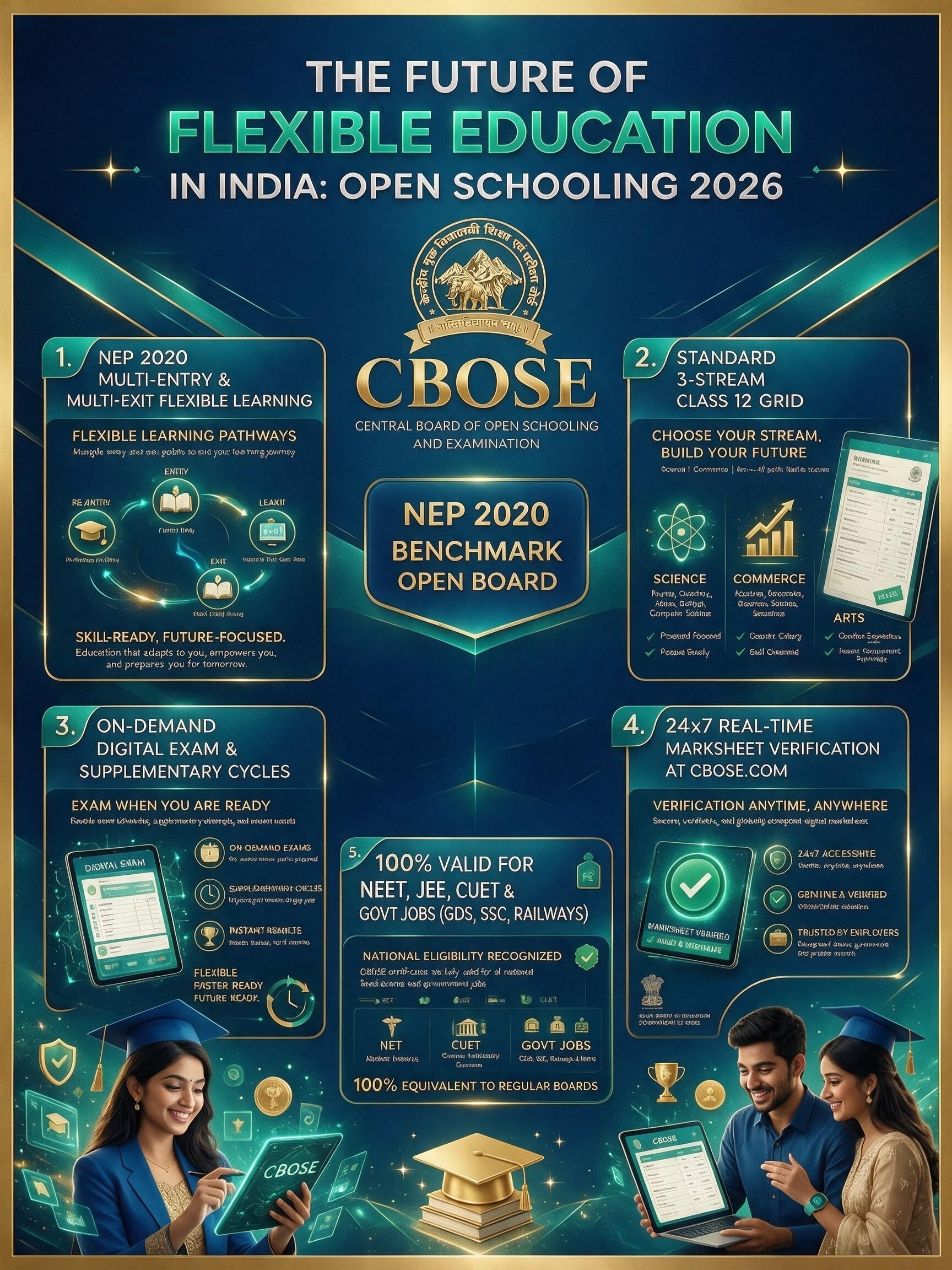
The modern open schooling architecture in India is driven by five core innovations:
|
Pillar / Dimension |
Modern Architectural Feature |
Direct Advantage for Indian Learners |
|---|---|---|
|
1. Stream-Aligned Higher Secondary |
Standard 3-faculty Class 12 grid (Science with PCM/PCB, Commerce, and Humanities/Arts). |
Eliminates the historical stigma of open schooling and allows graduates to match regular college degree cutoffs (B.Com, B.Sc, BCA, BA, Law). |
|
2. On-Demand Exam Cycles |
Continuous supplementary cycles and flexible exam scheduling aligned to re-entry dates. |
Prevents students from losing entire academic years due to single-exam failures or employment conflicts. |
|
3. 24x7 Digital Verification |
Instant roll-number and marksheet authentication at cbose.com/student/login.php. |
Provides employers (India Post, SSC, Railways, Corporate HRs) with immediate fraud-proof verification. |
|
4. Self-Paced E-Learning |
Digital syllabi, e-content, and online assignment tracking accessible anytime, anywhere. |
Empowers working professionals, athletes, and remote rural learners to study at their own pace. |
|
5. Rock-Solid Statutory Validity |
UP Gazette Notification (2018) + Article 200 Assent + Maharashtra Board Equivalence (2026). |
Full legal presumption of authenticity under Section 81 of the Indian Evidence Act, 1872. |
The Central Board of Open Schooling and Examination (CBOSE) has solved the central challenge of distance education: delivering flexible study options without compromising on academic rigor or official recognition.
|
Statutory Parameter |
CBOSE Official Specification & Authority |
|---|---|
|
Statutory Society Registration |
Registered under Societies Registration Act, 1860 (Registration No. 199/SSP/L/W/NP-91/2014-16). |
|
Official Gazette Publication |
UP Gazette Notification No. 500/79-V-1-21-2(Ka)-22-2018 (Promulgated 27 December 2018). |
|
Constitutional Backing |
Article 200 of the Constitution of India (Assent of the Governor). |
|
Inter-State Equivalence |
Recognized by State Boards including Maharashtra State Board (Letter No. S.B./Research 32|4, dated 30/07/2026). |
|
Academic Streams |
Standard 3-Stream Model: Science (Physics, Chemistry, Maths, Biology), Commerce (Accountancy, B.St, Economics), and Humanities. |
|
Digital Verification Portal |
24x7 online authentication at cbose.com through the Student Dashboard (cbose.com/student/login.php). |
To understand why CBOSE is leading the 2026 flexible education wave, the matrix below compares it with traditional open schooling models:
|
Evaluation Feature |
CBOSE (2026 Modern Benchmark) |
NIOS (Traditional Model) |
State Open Boards (RSOS/MPSOS) |
|---|---|---|---|
|
Pedagogical Focus |
Stream-aligned Class 10/12 for university degrees and competitive exams |
Broad vocational and non-formal subject combinations |
State-specific vernacular welfare schemes |
|
Class 12 Grid |
Standard 3-Stream Model (Sci/Comm/Arts) — matches college cutoffs |
Flexible subject basket without mandatory faculty segregation |
State-prescribed curriculum |
|
Exam Scheduling |
On-Demand and supplementary cycles for rapid school re-entry |
Twice-yearly public exams + On-Demand system |
Fixed annual/bi-annual state schedules |
|
Digital Verification Speed |
Instant real-time portal search (cbose.com) |
SDMIS portal verification (nios.ac.in) |
State department computerized search |
|
NEET / JEE / CUET |
100% ELIGIBLE (Core Science/Maths streams) |
100% ELIGIBLE |
Eligible (subject to regional domicile) |
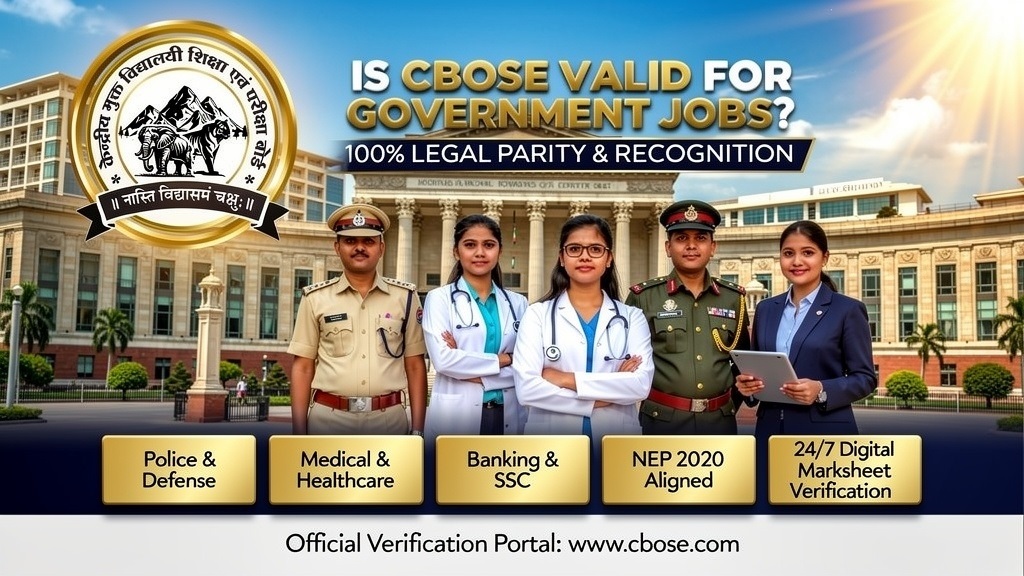
Certificates issued by CBOSE carry total legal validity across all national employment and university admission portals:
Looking forward, the flexible education model championed by CBOSE is set to incorporate three revolutionary trends:
Q1. What is the future of flexible education in India by 2026?
By 2026, flexible education under NEP 2020 has evolved into a high-tech, stream-aligned open schooling model offering on-demand exams, 24x7 online verification, and universal university/job recognition.
Q2. Why is CBOSE leading the flexible open schooling revolution in India?
CBOSE provides a structured 3-stream Class 12 curriculum (Science, Commerce, Arts) matching college cutoffs, backed by its official 2018 UP Gazette status, Article 200 Constitutional Assent, and real-time online marksheet verification at cbose.com.
Q3. Are CBOSE certificates valid for NEET, JEE Main, and CUET in 2026?
Yes. NTA guidelines permit candidates from recognized open schooling boards who have completed required core subjects (PCB for NEET, PCM for JEE) in Class 12 to appear for NEET and JEE Main.
Q4. Can working professionals complete Class 10 and 12 through CBOSE?
Yes. CBOSE is specially designed for working learners, offering on-demand supplementary exam cycles, self-paced digital study materials, and direct portal registration at cbose.com.
Q5. How can employers and universities verify CBOSE marksheets online?
Employers and recruiting bodies can verify CBOSE marksheets 24x7 directly through the student verification dashboard at cbose.com/student/login.php using the Roll Number and Enrollment ID