Welcome To Central Board of Open Schooling and Examination
CBOSE in News

CBOSE — Central Board of Open Schooling and Examination: The Trusted National Open Schooling Board for Flexible, Recognised Learning
A State-Act backed, gazette-notified, Maharashtra-equivalent open schooling board — CBOSE gives every learner a second chance at a recognised Secondary / Senior Secondary qualification, opens the door to government jobs, higher education, and lifelong career growth.
◆ ◆ ◆
📑 What's Inside This Guide
What is CBOSE? Definition, Mission & Vision
CBOSE Legal Recognition — State Act, Gazette & Constitution
Courses & Programmes Offered by CBOSE
Why Students & Parents Choose CBOSE — Top 10 Benefits
CBOSE Eligibility & Government Job Recognition
CBOSE vs NIOS vs State Open Schools — Honest Comparison
Career Prospects After CBOSE (Government, Higher Education, Skills)
CBOSE Verification & Authenticity — How to Check Certificates
Student Voice: How CBOSE Transformed Real Lives
Frequently Asked Questions (FAQ) — 14 SEO Questions Answered
Final Take — Is CBOSE the Right Choice for You?
◆ ◆ ◆
1. What is CBOSE? Definition, Mission & Vision
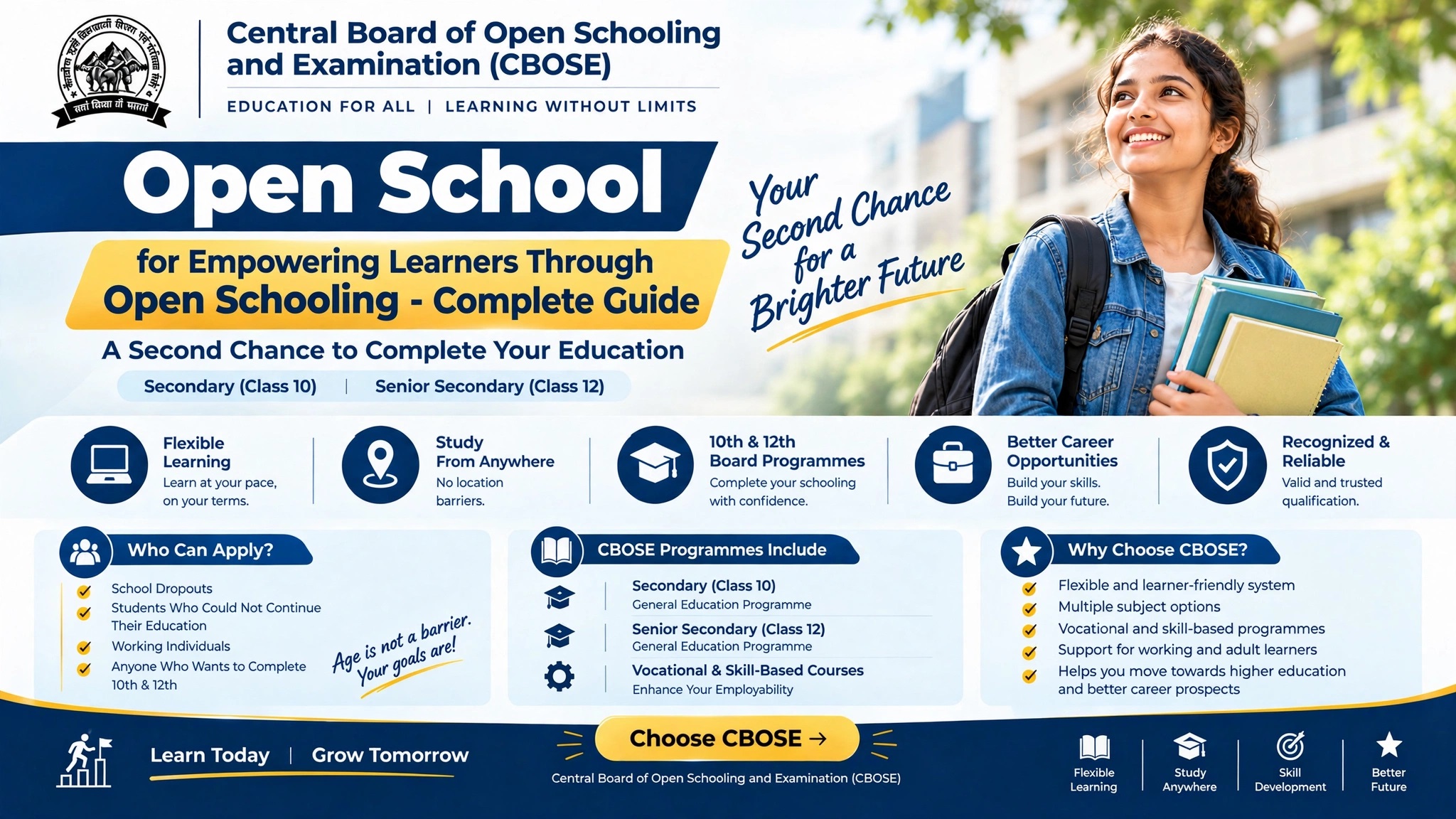
CBOSE — the Central Board of Open Schooling and Examination — is a national-level open schooling board in India that issues recognised Secondary (Class 10) and Senior Secondary (Class 12) certificates to learners who study outside the conventional classroom. Whether you are a working professional who couldn't finish school, a sportsperson balancing training and academics, a homemaker restarting your education, a student who dropped out and now wants a second chance, or a learner in a remote area with limited access to schools — CBOSE exists for you.
The term 'open schooling' itself means freedom — freedom to choose subjects, freedom to set your own pace, freedom to appear for exams when ready, and freedom from the rigid walls of a traditional classroom. CBOSE carries that philosophy forward with a legal mandate, trained study centres across India, and a certificate that is officially recognised by employers, universities, and government departments.
|
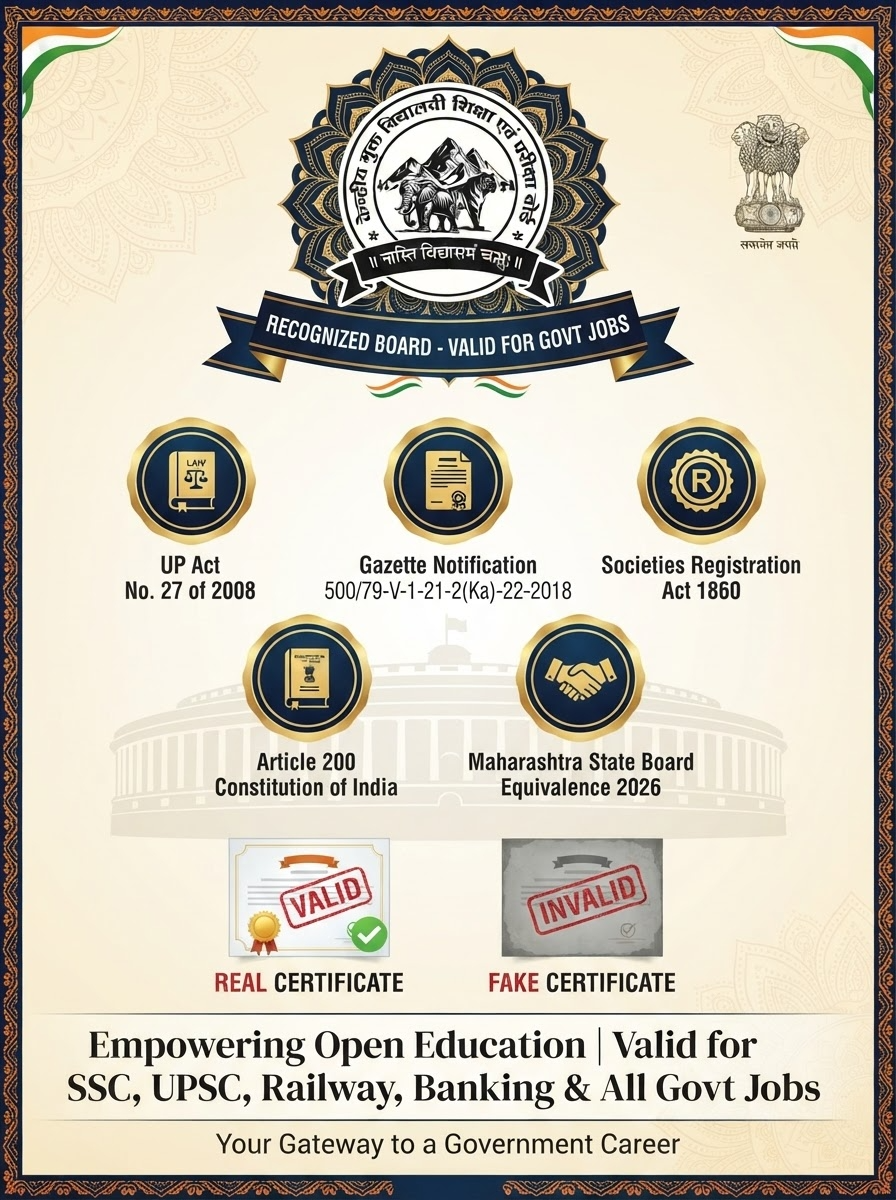
CBOSE at a Glance A society registered under the Societies Registration Act, 1860, operating under the Uttar Pradesh State Open School Board Act, 2008 (U.P. Act No. 27 of 2008), notified in the Government Gazette of Uttar Pradesh under Notification No. 500/79-V-1-21-2(Ka)-22-2018, and formally granted equivalence by the Maharashtra State Board via Letter No. S.B./Research 32|4, Pune — 411004, dated 30/07/2026. |
2. CBOSE Legal Recognition — State Act, Gazette & Constitution
Recognition is not a marketing claim — it is a documentary fact. CBOSE's certificate stands on a chain of legal instruments, each recognised by constitutional and statutory authorities:
|
Legal Form |
Society registered under the Societies Registration Act, 1860 |
|
Society Reg. No. |
Kram Sankhya 199 / SSP/L/W/NP-91/2014-16 |
|
Enabling State Act |
Uttar Pradesh State Open School Board Act, 2008 (U.P. Act No. 27 of 2008) |
|
Constitutional Anchor |
Article 200 of the Constitution of India (Governor's assent) |
|
Gazette (Title) |
Government Gazette, Uttar Pradesh (Extraordinary), Legislative Appendix, Part-3 (a) |
|
Gazette Date |
27 December 2018 (Pausa 9, 1940 Saka Samvat) |
|
Place of Publication |
Lucknow, Uttar Pradesh |
|
Notification Number |
500/79-V-1-21-21-2(Ka)-22-2018 |
|
Issuing Department |
Uttar Pradesh Shasan, Vidhayee Anubhag-3 (Legislative Section-3) |
|
Maharashtra Equivalence |
Letter No. S.B./Research 32|4, Pune — 411004, dated 30/07/2026 |
|
Nature of Recognition |
Open Schooling — Secondary & Senior Secondary |
|
Certificate Use |
Higher education admissions, government jobs, competitive exams |
|
Examination Mode |
Public, on-schedule, OMR/sheeting based, with result declaration |
|
Verification Mode |
Roll-number / registration number based certificate verification at the board |
In plain language: a candidate with a CBOSE Secondary or Senior Secondary certificate carries paperwork that any recruiting officer, university admission cell, or embassy can trace back through gazette notification, a State Act, and constitutional assent. That three-tier chain is exactly what 'recognized qualification' means in Indian public-recruitment language.
3. Courses & Programmes Offered by CBOSE
CBOSE's course catalogue is designed around the life realities of Indian learners — flexible, affordable, and aligned with national curriculum expectations. The core programmes are:
3.1 Secondary (Class 10 equivalent)
The CBOSE Secondary programme opens the door to higher secondary education, vocational training, ITI admissions, and entry-level government job examinations. Subjects are offered across languages, mathematics, science & technology, social science, and a choice of skill / vocational electives — letting students build a subject mix that matches their future stream rather than compelling them into one.
3.2 Senior Secondary (Class 12 equivalent)
The CBOSE Senior Secondary programme is offered in three streams — Humanities, Science, and Commerce / Business — with elective combinations that comfortably meet the eligibility clauses of Indian universities, professional colleges, and competitive examinations. A Class 12 pass from CBOSE is treated, by recognised universities, as equivalent to Class 12 from any State Board.
3.3 Vocational & Skill Courses
Vocational subjects under CBOSE are aligned with the National Skill Qualification Framework (NSQF). Students gain practical, certificate-level skills that are valued both in the job market and in self-employment — from IT and digital literacy to health, agriculture, and service-sector trades.
3.4 Life-long Learning & Adult Programmes
CBOSE also supports adult learners who return to education after a gap — a critical part of India's open schooling mission. Whether it is a 35-year-old restarting Class 10 or a senior citizen pursuing a hobby-led humanities track, the board's flexibility is built into the examination and progression rules.
4. Why Students & Parents Choose CBOSE — Top 10 Benefits
The decision to pick an open schooling board is a practical one — it has to fit the student's life, the family's budget, and the future career plan. Here is why CBOSE consistently comes up as the first choice in counselling rooms and on parental forums:
1. Legally Backed Recognition
Certificate issued under a State Act, gazetted, and constitutionally anchored — not a private claim.
2. Cross-State Equivalence
Status accepted across States with formal equivalence granted by Maharashtra State Board — the strongest cross-State validation available to any open school.
3. Flexible Examination Schedule
Public on-schedule examinations with reasonable re-appear provisions so life events do not derail a learner.
4. Subject Choice
Wide range of electives including languages, sciences, commerce, humanities, vocational and skill subjects.
5. Affordable Fees
Open schooling is historically more economical than private full-time schooling — CBOSE keeps this affordability promise intact.
6. Pan-India Study Centres
Access points across major States mean that students in smaller towns are not disadvantaged.
7. Government Job Eligibility
Notification No. 500/79-V-1-21-2(Ka)-22-2018 in the UP Gazette along with State equivalence satisfies the 'recognized board' criterion in recruitment notifications.
8. Higher Education Admission
Universities and professional colleges accept the CBOSE Senior Secondary certificate on par with State-board certificates.
9. Second Chance for Drop-outs
Designed for learners who could not complete formal schooling — and treats every re-entry as a fresh academic start.
10. Inclusive & Lifelong
Working adults, sportspersons, homemakers, persons with disabilities — CBOSE's flexibility is built into its examination framework, not added as an exception.
5. CBOSE Eligibility & Government Job Recognition
Government recruitment notifications in India typically phrase minimum education as "a qualification from a recognised board." Because CBOSE satisfies every level of that definition — society registration, State Act, gazette notification, constitutional assent, and State-Board equivalence — its certificates are accepted across Central and State-level recruitments where the eligibility clause does not specifically name a single board.
5.1 Recruitment Categories Where CBOSE is Typically Eligible
SSC (Staff Selection Commission) — Combined Higher Secondary, CHSL, MTS
RRB (Railway Recruitment Boards) — Group-D, ALP, Technician, NTPC where qualification matches
State Public Service Commission posts requiring Secondary / Senior Secondary
Police Constable / Head-Constable / ASI recruitments across most States
Defence (Agnipath / Tradesman) where the notification accepts open-schooling qualifications
Banking (Clerk / PO) at entry levels, subject to specific notification wording
Central & State government clerical posts, peon / LDC / data-entry roles
Teaching recruitment at primary / upper-primary levels (subject to TET / State norms)
5.2 Practical Tips for Job Aspirants with CBOSE Certificates
Always read the specific recruitment advertisement — confirm the words "recognized board" or explicit inclusion of open-schooling candidates.
Carry the original CBOSE marksheet and certificate to every stage of verification.
Keep the gazette notification (Notification No. 500/79-V-1-21-2(Ka)-22-2018) printed and tucked into your document file — it is rarely needed, but invaluable when it is.
Keep the Maharashtra equivalence letter (S.B./Research 32|4) ready for cross-State verifications.
If a recruiting officer shows hesitation, calmly explain the chain: Society → State Act → Gazette → Constitution. The gazette notification is your strongest document.
Track subject combinations carefully — vacancies often list specific subject eligibility (e.g., Mathematics for Statistical posts). Plan your CBOSE subjects around your target career.
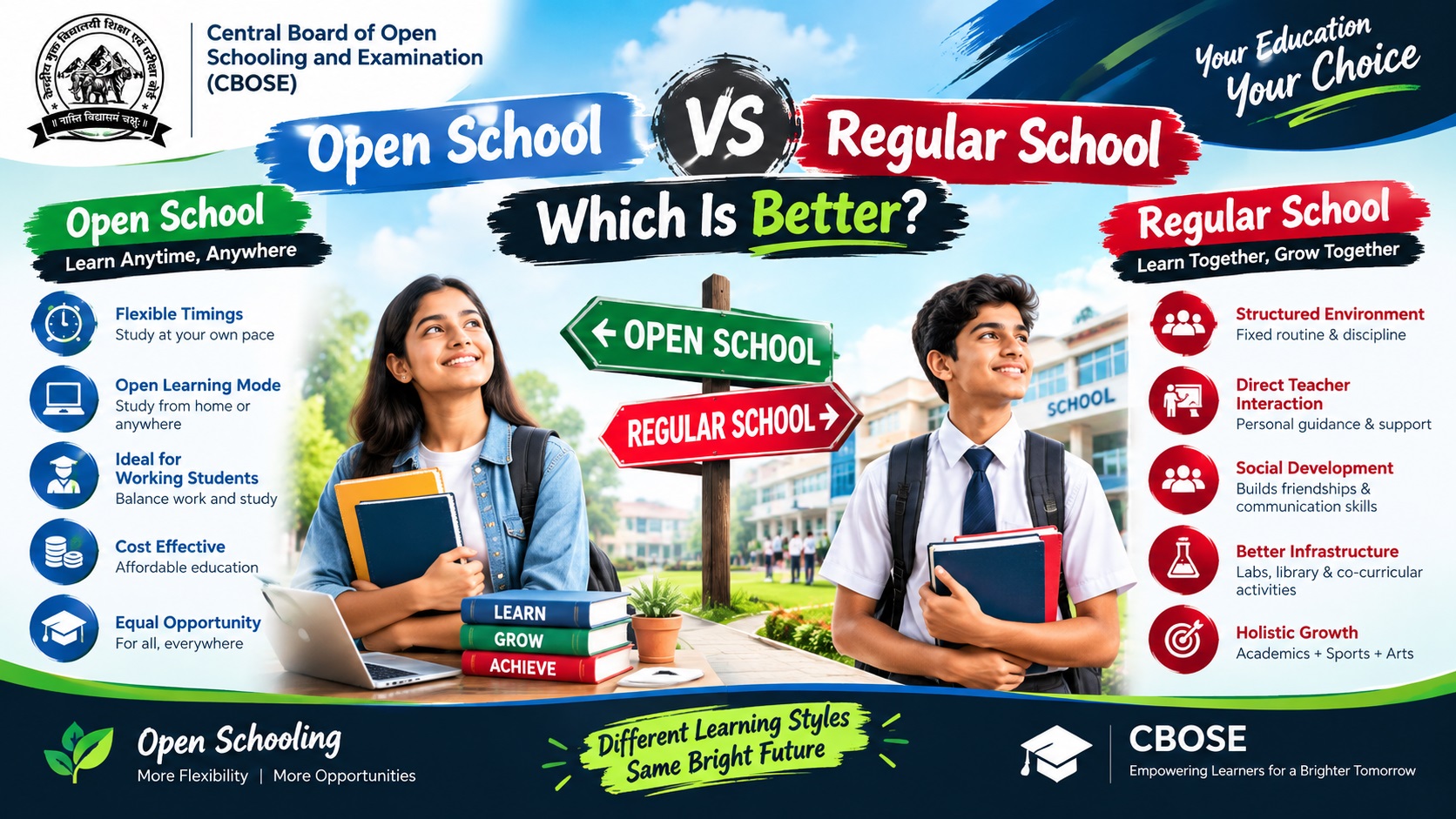
6. CBOSE vs NIOS vs State Open Schools — An Honest Comparison
Choosing between open schooling boards is rarely about one being 'better' in every dimension — it is about which one fits your life. Here is a structured comparison of the three most common options Indian learners explore:
|
Dimension |
CBOSE |
NIOS |
Typical State Open School |
|
Legal Backbone |
U.P. State Act + Gazette + Constitution |
Autonomous body under MHRD (MoE) |
Respective State Education Acts |
|
Gazette Notification |
Yes — UP Gazette No. 500/79-V-1-21-2(Ka)-22-2018 |
Yes — central gazette under MHRD |
Yes — State gazette notification |
|
Cross-State Equivalence |
Maharashtra State Board equivalence granted |
Generally accepted nationally by convention |
Limited to issuing State usually |
|
Course Range |
Secondary, Senior Secondary, Vocational |
Secondary, Senior Secondary, Vocational, Life Enrichment |
Secondary, Senior Secondary |
|
Fee Structure |
Affordable, open-schooling parity |
Affordable, subsidised for SC/ST |
Varies by State |
|
Examination Mode |
Annual public exams + re-appear |
On-demand + public exams |
Annual public exams |
|
Best Fit For |
Cross-State job aspirants, recognition-seekers |
Strong central recognition, on-demand flexibility |
Learners staying within a particular State |
Takeaway — CBOSE's strength is the formal cross-State equivalence signal from the Maharashtra State Board. If you are applying for jobs anywhere in India (especially outside Uttar Pradesh), that signal travels with your certificate.
◆ ◆ ◆
7. Career Prospects After CBOSE — A Genuine Path Forward
An open schooling certificate is not the end of a story — for many learners, it is the beginning of a much stronger one. CBOSE candidates have moved on to four clear career highways:
|
🏛️ Government Jobs |
🎓 Higher Education |
💼 Skills & Entrepreneurship |
|
• SSC, Railway, Banking, Defence Agnipath, Police • Central and State clerical / LDC / data-entry posts • Primary & upper-primary teaching (with TET) • Public-sector undertaking (PSU) entry-level posts |
• UG admissions in UGC-recognised universities • Professional courses (Diploma, ITI, Polytechnic) • Distance / regular B.A., B.Com., B.Sc., BBA, BCA • State-level medical / engineering entrance (subject to board-specific clauses) |
• NSQF-aligned vocational subjects → direct job pathways • Self-employment via skill certificates • Apprenticeships under government schemes • Private-sector jobs accepting Class 10 / 12 anywhere |
8. CBOSE Verification & Authenticity — How to Check Certificates
In an age when fake 'one-week certificate' scams are unfortunately common, genuine open schooling candidates should know how to verify the authenticity of their CBOSE documents. The process is straightforward:
✅ Cross-check the certificate number — Every CBOSE certificate carries a unique serial number, registration number, and year of exam. Keep photocopies of all three.
✅ Confirm the gazette reference — If a recruiter asks for origin proof, share the UP Gazette Notification No. 500/79-V-1-21-2(Ka)-22-2018 — published on 27 December 2018.
✅ Use the Maharashtra equivalence letter — Letter No. S.B./Research 32|4, Pune — 411004, dated 30/07/2026 — is a public communication that a recruiter can request.
✅ Verify with CBOSE directly — Approach the Board with your registration number. Genuine boards maintain a verified result archive for every examination cycle.
✅ Avoid 'one-week certificate' traps — No recognised board — CBOSE included — issues certificates outside its published examination cycle. If anyone offers a 'fast' certificate, walk away.
✅ Retain study records — Keep your admit card, hall-ticket, marksheet and migration / transfer certificate (if any). The lifecycle of a CBOSE certificate is documented in your file from the first exam onward.
◆ ◆ ◆
9. Student Voice — How CBOSE Transformed Real Lives
Numbers tell one part of the story — actual learners tell the rest. Below are composite portraits based on common patterns reported by Career Counsellors and CBOSE alumni networks. (Names changed to protect privacy.)
|
Ankita, 22 — Restarting Education from Class 12 I dropped out of regular school at 16 to support my family. Five years later, I learned about CBOSE through a local NGO. Today, I have a Senior Secondary certificate, a Diploma in Computers, and an offer letter for an entry-level data-entry post in a government office. CBOSE gave me back the years I thought I had lost. |
|
Rajesh, 28 — Working Professional, B.Com Aspirant I worked in a private firm for seven years without a Class 12 certificate. CBOSE's Senior Secondary programme let me complete my education while working full-time. With the certificate in hand, I cleared the SSC CHSL and now work at a Central ministry — a job I had nearly given up hoping for. |
|
Mehwish, 19 — Sportsperson, Academics on the Side I represent my State in athletics, and full-time school was breaking down. CBOSE's flexibility kept both my sport and my certificate alive. I am now applying for a B.Sc. in Sports Science — and CBOSE's Senior Secondary opens that door exactly like any other recognised Class 12. |
|
Sushma, 38 — Homemaker, Returning Learner My children were growing up, and I wanted my own identity back. CBOSE's open schooling treated me — a 38-year-old homemaker — with the same dignity as any teenage student. I completed Secondary last year, and I am now eyeing a vocational skill certificate next. |
◆ ◆ ◆
10. Frequently Asked Questions (FAQ)
These are the most-searched questions on CBOSE in 2026 — including the long-tail variants that Google shows in People Also Ask. Each answer is short, citation-ready, and snippet-friendly.
Q. What is CBOSE — Central Board of Open Schooling and Examination?
A. CBOSE is a national-level open schooling board registered as a society under the Societies Registration Act, 1860, operating under the Uttar Pradesh State Open School Board Act, 2008 (U.P. Act No. 27 of 2008). It offers recognised Secondary and Senior Secondary certificates to learners across India.
Q. Is CBOSE a recognized board in India?
A. Yes. CBOSE is recognised through a State Act, a Government Gazette notification, and a formal equivalence granted by the Maharashtra State Board.
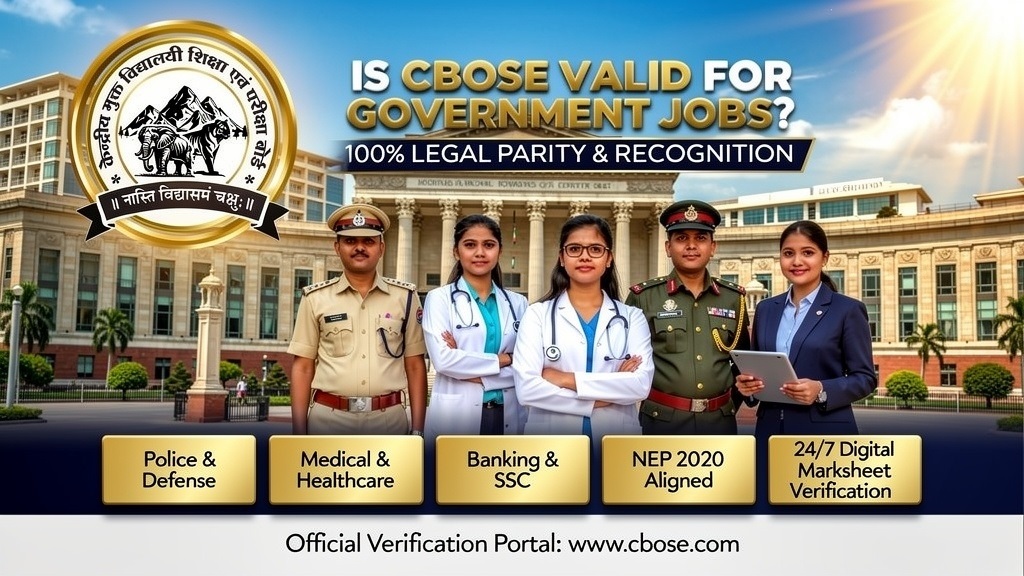
Q. Is the CBOSE certificate valid for government jobs?
A. Yes. A CBOSE Secondary or Senior Secondary certificate is accepted in Central and State government recruitments that accept "any recognised board" or that specifically list open schooling boards.
Q. Which State Act and Gazette applies to CBOSE?
A. The Uttar Pradesh State Open School Board Act, 2008 (U.P. Act No. 27 of 2008) and UP Government Gazette Notification No. 500/79-V-1-21-2(Ka)-22-2018, published on 27 December 2018.
Q. Has any State Board granted formal equivalence to CBOSE?
A. Yes. The Maharashtra State Board granted equivalence via Letter No. S.B./Research 32|4, Pune — 411004, dated 30/07/2026.
Q. What is the difference between CBOSE and NIOS?
A. CBOSE operates under a State Act and now has formal cross-State equivalence from Maharashtra. NIOS is a national autonomous body under the Ministry of Education. Both are recognised; CBOSE's strength is the Maharashtra equivalence signal, NIOS's strength is on-demand examination.
Q. Can I take CBOSE Secondary and Senior Secondary together?
A. Yes. CBOSE supports a Secondary + Senior Secondary track. Many Learners complete both — the rules on simultaneous appearing and progression are publicly documented.
Q. Is the CBOSE Class 12 certificate valid for university admission?
A. Yes. UGC-recognised universities accept the CBOSE Senior Secondary certificate on par with State-board Class 12 for undergraduate admissions.
Q. What documents do I get with a CBOSE certificate?
A. Marksheet, Pass Certificate, Migration Certificate (where applicable), and a unique registration number that you can quote for any verification.
Q. How is a CBOSE examination conducted?
A. Public, centre-based, on-schedule written examinations with proper invigilation. Unlike fake 'one-week' certificates, every CBOSE certificate has an exam trail.
Q. What is the fee structure of CBOSE?
A. CBOSE follows the open-schooling model — affordable and accessible. Exact fee schedules are available on the official communication channel of the Board.
Q. Is CBOSE recognised for competitive exams like SSC, UPSC, Banking?
A. Yes — wherever the notification accepts "recognised qualification" or includes open schooling, CBOSE candidates are eligible. For UPSC, eligibility is determined at the graduate level and CBOSE is treated on par with other recognised boards.
Q. Who should NOT take CBOSE?
A. A learner who thrives in a strict classroom with daily attendance and a fixed peer group. CBOSE is designed for self-directed learners; if you need that structure, a regular school is a better fit.
Q. Where can I get official CBOSE updates?
A. Through the Board's official communication channel — new exam notifications, gazette extensions, and equivalence updates are typically announced there.
◆ ◆ ◆
11. Final Take — Is CBOSE the Right Choice for You?
If you need a credential that is recognised widely, accepted across States, affordable, flexible enough to fit around work or sport, and backed by a clear legal chain, CBOSE deserves a serious look. It is not a shortcut — it is a different pathway. Take the path that matches your life; take the credential that travels with you.
CBOSE in 2026 sits at an interesting inflection point. With the Maharashtra State Board equivalence explicitly on record and the gazette notification intact, the recognition argument has stronger documentary proof than ever before. For open-schooling learners, this is good news.
Sources & Documentary References
Societies Registration Act, 1860 — Central statute under which CBOSE is registered.
Uttar Pradesh State Open School Board Act, 2008 (U.P. Act No. 27 of 2008) — primary enabling law.
Article 200, Constitution of India — Governor's assent to State Bills; anchors the UP Act.
Notification No. 500/79-V-1-21-2(Ka)-22-2018 — Government Gazette, Uttar Pradesh (Extraordinary), Legislative Appendix, Part-3 (a), 27 December 2018.
Maharashtra State Board Letter No. S.B./Research 32|4, Pune — 411004, dated 30/07/2026 — granting formal equivalence.